
Story: Phan Quoc Vinh
Photos: Le Tan Thanh
Artisan Vo Ngoc Hung uses tropical almond leaves to create conical hats, fans, paintings, and other original creations imbued with the spirit of Hue.
In 2018, seeking to give traditional conical hats from Hue a new look while preserving their familiar form, Hung decided to replace the standard palm leaves with those from tropical almond trees. These broad leaves are sufficiently thick and have a network of veins strong enough to retain their structure after the fleshy part of the leaf is removed.
The new idea that grew out of a leaf
During a trip to the hills of Binh Dien, Hung came across some wild tropical almond trees growing along a stream. Their large leaves, with clearly defined veins, immediately reminded him of his previous experience working with bodhi leaf skeletons and sparked a question: could these stripped forest leaves be used to make a traditional Hue conical hat?
That seemingly simple question led to a long period of experimentation. Hung would travel dozens of kilometers into the forest, only to return with barely a dozen leaves that met his demanding standards. Each leaf had to be sufficiently thick and mature, and free of insect damage or tears. If it was too young, the entire structure could disintegrate during treatment. Even a small imperfection might cause the leaf to tear once the soft tissue was removed.
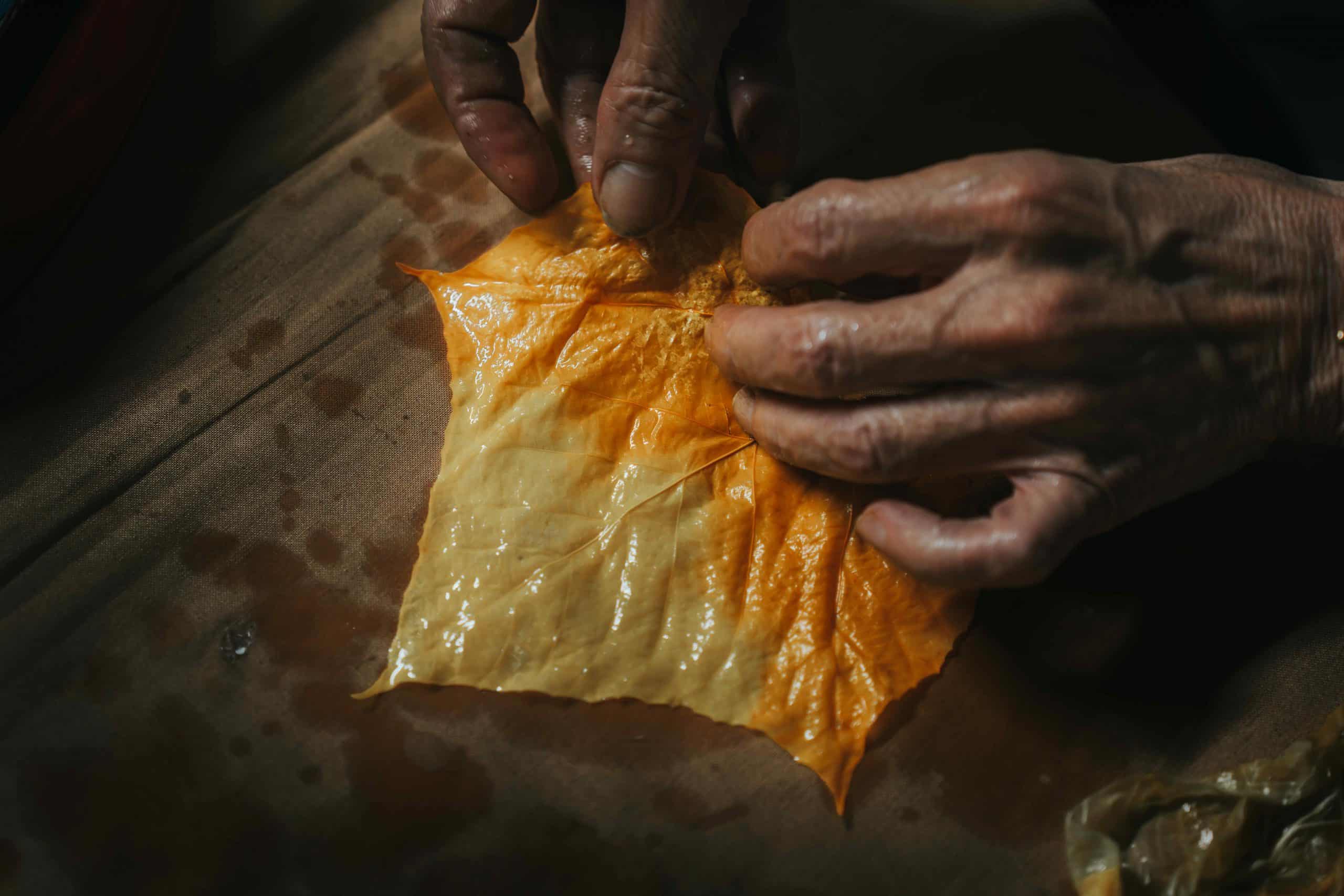
Each carefully chosen tropical almond leaf then underwent a process that took about six weeks, during which Hung gradually removed the soft tissue to reveal a delicate, lace-like network of veins. The cleaning stage required great patience and an exceptionally gentle touch, so as not to break the delicate veins and negate hours of painstaking work.
Once cleaned, the leaf skeletons are dried, shaped, and arranged over the hat’s frame. Their veins must be positioned harmoniously from the crown to the brim before being stitched together using traditional conical-hat-making techniques. A single hat usually requires around 13 to 15 leaves. From the first step of processing to completion, the entire process can take nearly two months.
In an era when technology can shorten many stages of production, Hung does not rule out modern techniques. However, he is determined to preserve the essence of traditional craftsmanship, particularly the manual skills passed down through generations and production methods that minimize chemical use and are more environmentally friendly.
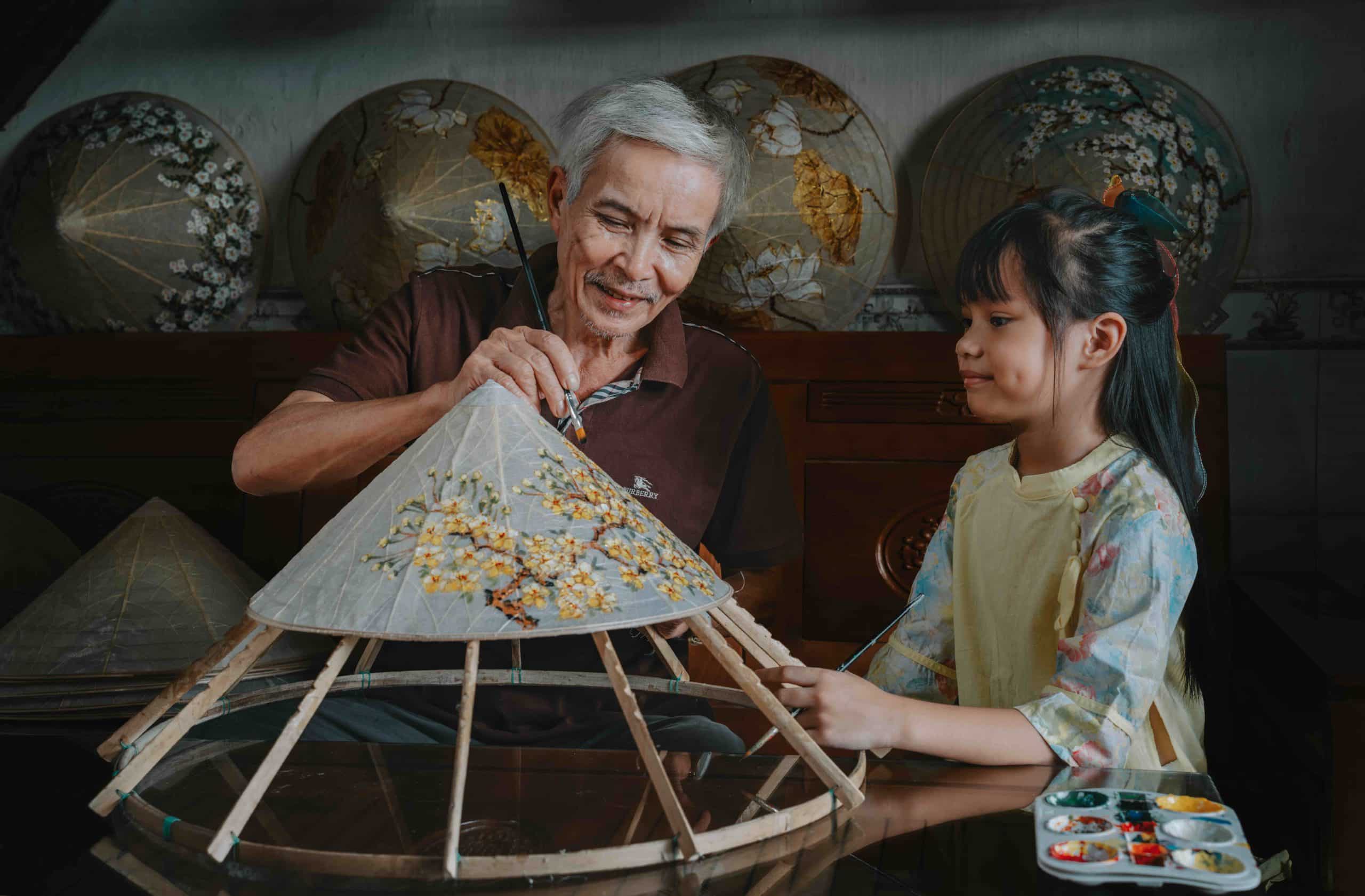
For Hung, what makes a handmade object special is the time spent observing and understanding the material, combined with the artisan’s experience. Every leaf differs in thickness, vein structure, and durability, making it impossible to follow a simple fixed production formula.
Because no two leaves have the same vein patterns, creating two identical finished hats is extremely difficult. Each conical hat made from tropical almond leaf skeletons is therefore a unique work of art rather than a standardized made-to-order product, Hung explained.
Innovation should not abandon tradition
From the beginning, Hung’s ambition was not simply to create a piece of headwear. He wanted his tropical almond leaf hats to serve as works of decorative art, fashion accessories, and gifts. They tell a story about Hue.
After repeated failures and many refinements, his products gradually improved, becoming more resistant to humidity and water. Interestingly, the leaf’s translucency – once considered a disadvantage – eventually became one of its most recognizable aesthetic features.
Hung explained that if he had used the same leaves to create something completely unfamiliar to Hue, it might not have been well received. The conical hat is deeply intertwined with the identity of this poetic land. By changing the material while preserving the hat’s familiar silhouette, he refreshed a traditional product without disconnecting it from the place where it was born.
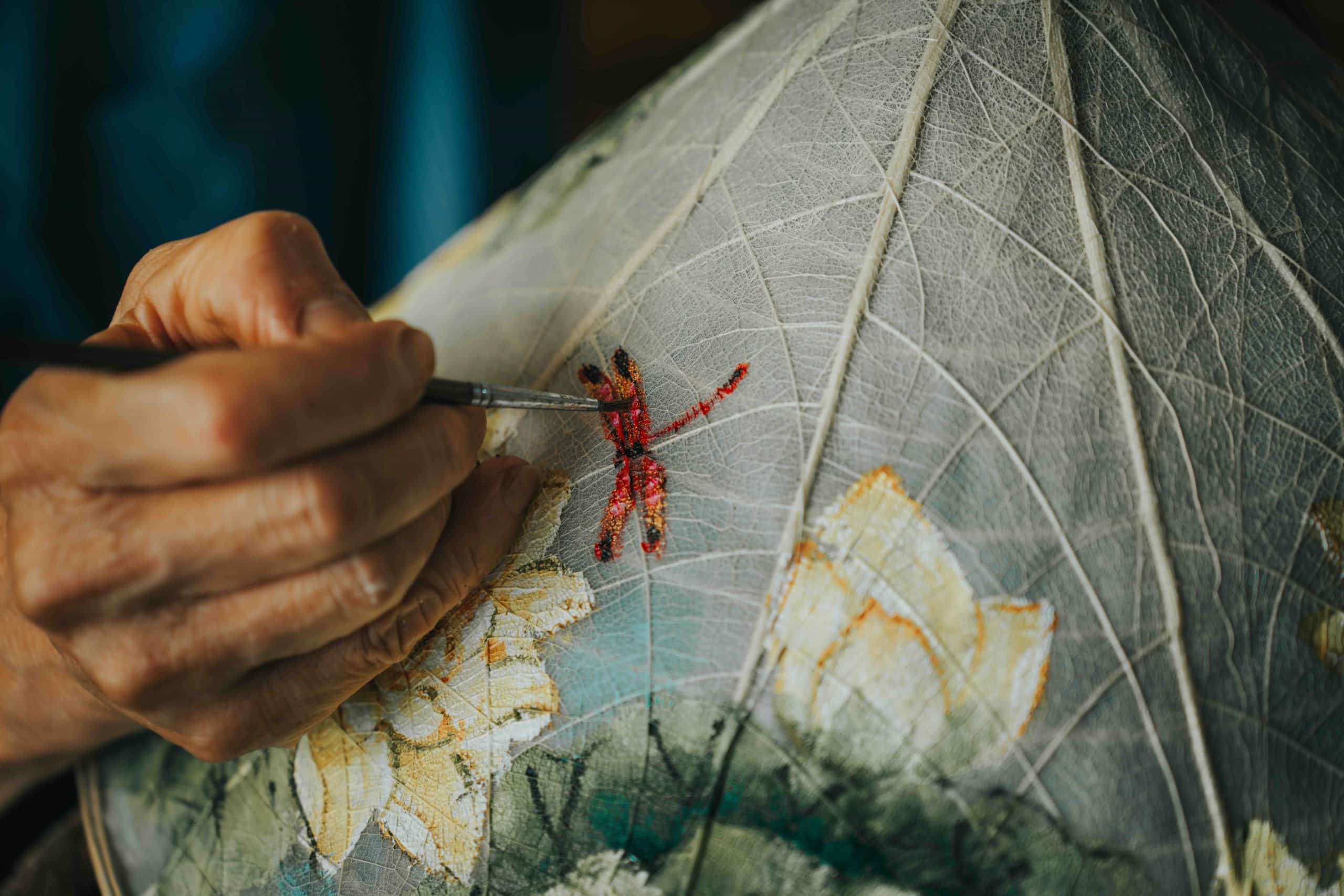
That philosophy reflects the message he hopes to share with younger generations seeking to reinvent traditional crafts: innovation must remain connected to local identity, while creators must be willing to experiment, take risks, and accept failure.
In recent years, as similar products have appeared on the market, Hung has resisted the temptation to pursue mass production. Instead, he continues to follow a simple philosophy: “Make fewer things, but make them refined. There is no need to produce a lot, but every product should carry an idea.”
For him, the value of craftsmanship does not lie in how many identical objects can be produced in a single day. It rests in ensuring that every piece leaving the artisan’s hands carries its own imprint, story, and reason for being.
From the vast forests to the ancient streets of Hue, these wild tropical almond leaves have become more than simple handicraft materials. They offer a quiet lesson in how to approach heritage: tradition does not have to stand still, but innovation becomes truly meaningful only when creators remain faithful to the identity of the place where their journey began.