Story: Phan Ngoc Khue
Photos: Kim Dung
More than a funeral painting, Do linh maps a spiritual voyage, revealing how a northern upland community has understood life, death, and what lies beyond.
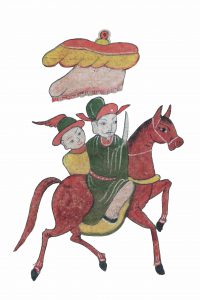
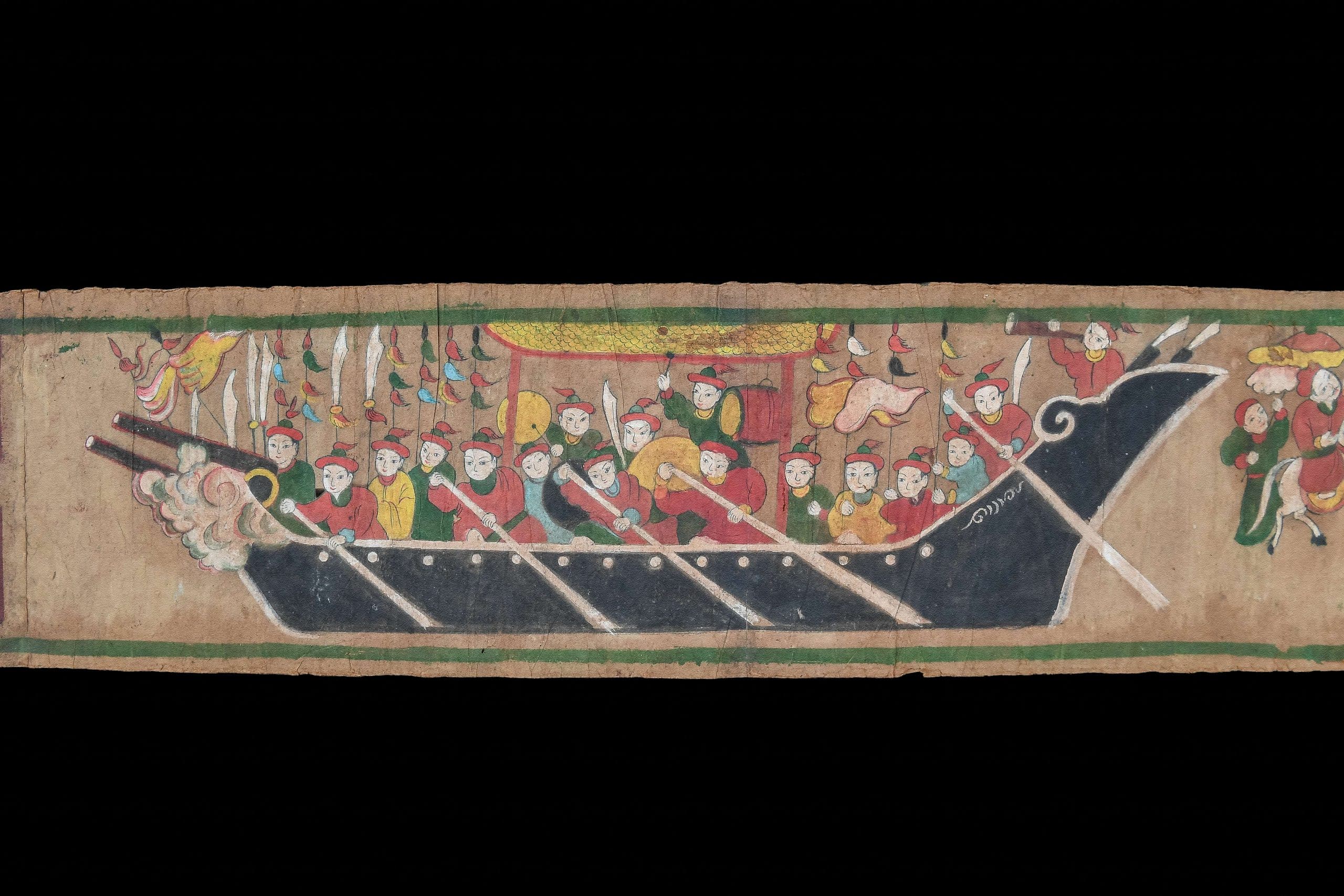
Among the Daoist ritual paintings in the Vietnam National Museum of Fine Arts’ collection, Thien thuong do, also known as Do linh, is particularly remarkable. Donated by the collector Pham Duc Si, the painting measures 26cm by 13m and is executed in natural pigments on do paper. With its unusually long format, it unfolds before the viewer like a spiritual pathway, guiding the deceased from the human world to a peaceful realm in accordance with the community’s beliefs.
For many ethnic groups in the northern mountains of Vietnam, funeral rites are not simply a final farewell to the dead, but a journey to escort the soul to another world. Within that setting, Do linh serves as a visual “road.” This type of painting is typically used in the funerals of Daoist thay Tao, who have been ordained as high-ranking ritual masters. With an understanding of ritual practice, the thay Tao acts as a bridge between humans and the spiritual world, praying for peace and safeguarding the community’s inner life.
Along with its religious significance, Do linh is noteworthy for how earlier generations used a visual language to depict the journey through the afterlife. The sendoff depicted in the painting is not a full stop at the end of a human life, but rather the beginning of a voyage marked by guides, songs, rituals, and the protection of both deities and the community. The soul of the deceased undergoes a solemn passage, traversing trials on the way to peace.
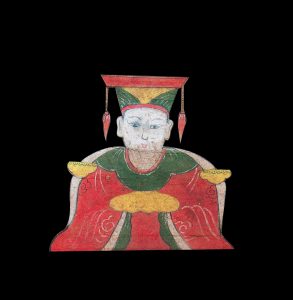
Across the painting, layers of images unfold like scenes from a folk film. Palanquins, parasols, and mourners form a funeral procession. A golden boat leaves the shore, evoking the crossing from illusion to enlightenment. There are immortals, deities, palaces, bridges, and symbolic rivers. Alongside Daoist elements such as the Jade Emperor, Nam Tao, and Bac Dau, the painting also contains traces of Buddhist ideology and folk beliefs, especially ideas of birth, rebirth, and the protection of the spirit midwives.
In artistic terms, Do linh is rendered in a simultaneous narrative mode, with multiple spaces appearing on a single pictorial surface. Processions, the spirit boat, heavenly palaces, bridges, rivers, and towers are arranged in sequence, allowing the viewer to “read” the painting like a long story. The linework is simple and rustic, with color applied mainly in flat areas. The restrained palette of black, white, red, yellow, and green is nonetheless highly evocative, creating a visual rhythm that feels both ancient and familiar.
Because the painting is extremely long yet narrow, the folk artist handled the composition with considerable flexibility. Some scenes are turned sideways, some figures are reduced in scale, and some spaces are suggested through doorways, arches, or simple geometric forms. It is precisely this stylization that gives ritual folk painting its distinctive beauty: rather than imitating reality, it opens onto a symbolic world in which every image carries a meaning of guidance, protection, and prayer.
Like many Daoist ritual paintings of the San Diu people, Do linh bears traces of Ming and Qing artistic influences from China and shows affinities with the ritual paintings of Cao Lan and San Chi communities in the eastern Liangguang region. These influences reflect histories of migration, cultural exchange, and the process by which the San Diu came to live in Vietnam, integrating with other northern upland communities and enriching this region’s cultural identity.
Seen from today’s perspective, Do linh is not only a rare ritual painting, but also a record of how a community has understood the boundary between life and death. Within that 13-meter scroll, one can see a belief in continuity, in moral aspiration, and in the support offered by family, community, and the spiritual world to the departed. In this work, folk art preserves profoundly humane reflections on human life.