Vinh Dav
On the golden terraces of northern Vietnam, discover a landscape shaped by nature and human endurance.
The season when rice ripens on the terraced fields of northern Vietnam is often celebrated for its brilliant golden hues spreading across the mountain slopes. From above, the sweeping curves of the terraces resemble gentle brushstrokes across the valleys, creating one of northern Vietnam’s most iconic landscapes. However, a panoramic view alone misses the finest part of this golden season: the people quietly working among the fields. Some beauty can only be fully appreciated up close, with the most meaningful stories carried on farmers’ shoulders.
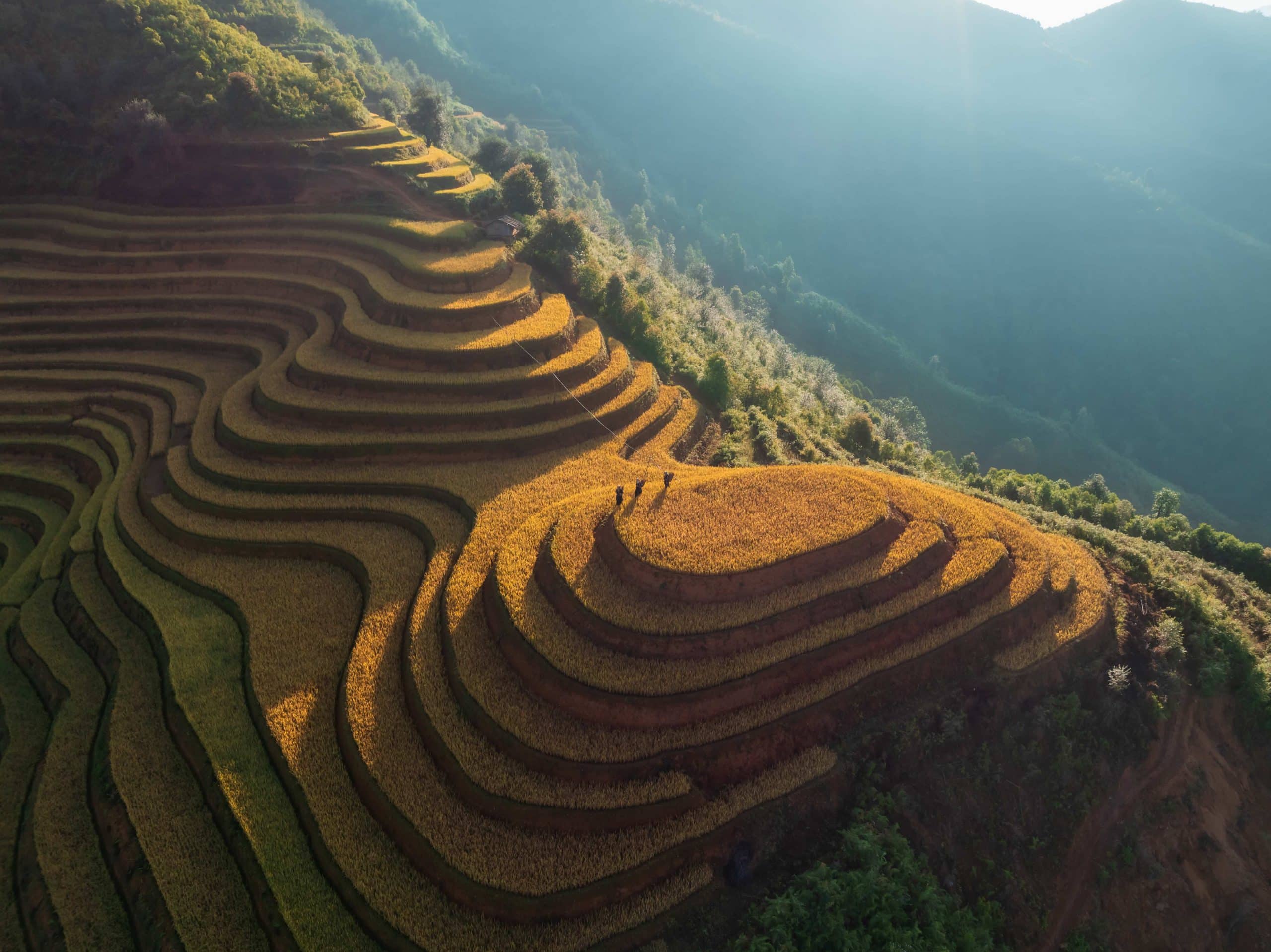
In the highlands, despite the mechanization of some tasks, the harvest has never been entirely a matter of machinery. Narrow ridges and steep terrain mean that many steps must still be carried out by hand. Bound tightly, bundles of rice are loaded onto carrying poles, harvesting spikes, or bamboo backpacks that have accompanied local people through countless seasons. From a distance, their movements may appear slow, yet each step reflects a dexterity honed over generations.
The terrain dictates the choice of tools used to transport rice. Where field surfaces are relatively flat, carrying poles made from mature bamboo are most common. These poles are shaved thin, creating a wide, flexible, and resilient surface that rests on the farmer’s shoulders. Across more challenging terrain, farmers opt for sturdier carrying spikes, some with sharpened ends that allow them to pierce rice bundles more easily.
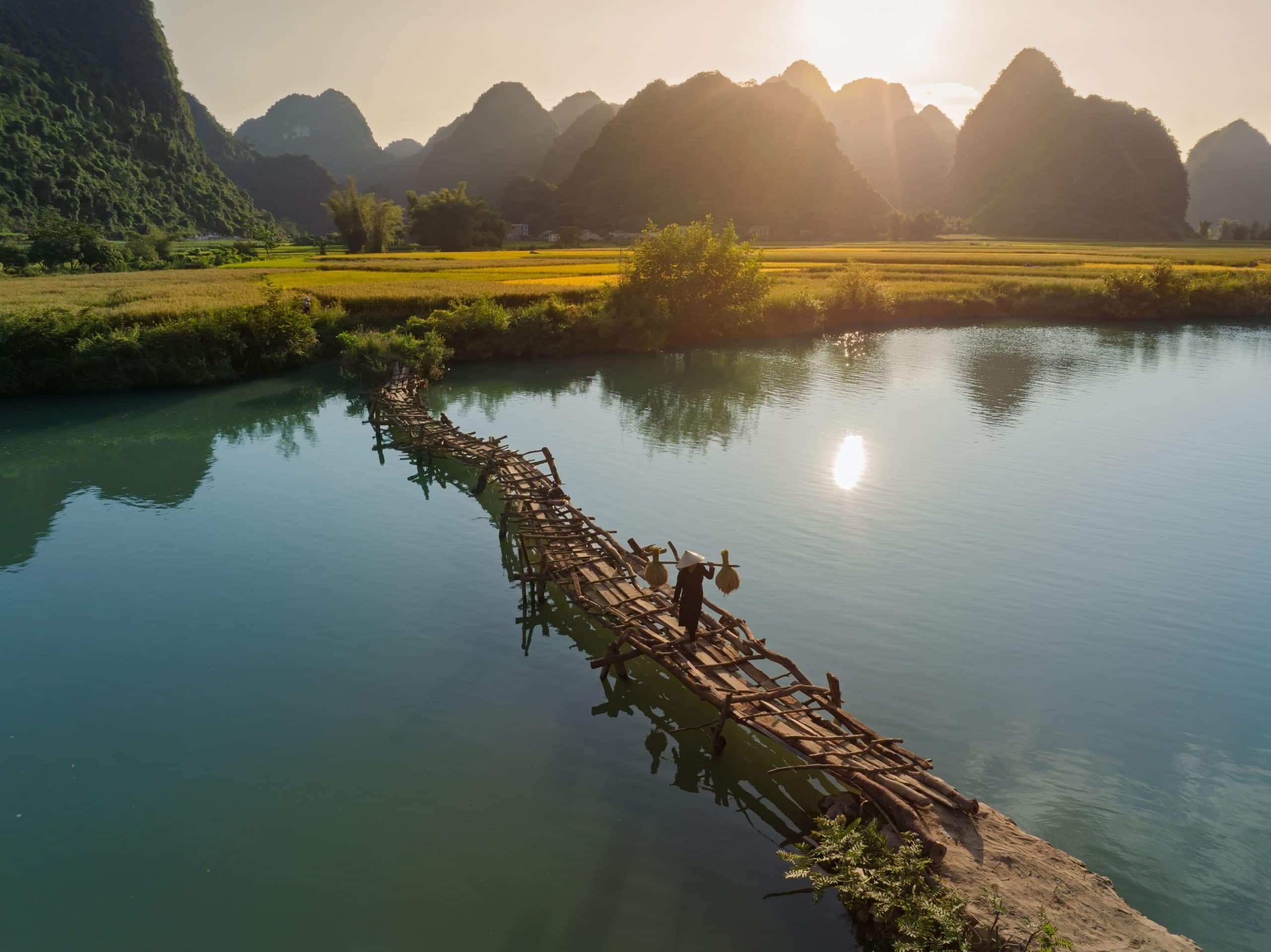
Once the rice bundles are gathered, farmers gently tilt their heads, hoist the pole onto their shoulders, and adjust the loads at both ends until perfectly balanced. The greatest challenge lies in maintaining this balance while walking along narrow mud ridges barely wide enough for a single footstep. Their shoulders are not muscular in the conventional sense. Instead, they are lean, sun-bronzed, and calloused from the carrying pole resting there season after season, a living testament to countless crops sown and reaped.
Where terraced slopes are high and steep, the iconic woven backpack (gui) on a farmer’s back becomes a familiar sight. Handwoven from bamboo or rattan, these backpacks feature broad shoulder straps and sometimes an additional forehead strap to distribute the weight evenly. Neatly bundled rice fills the basket, following farmers across rocky inclines and winding paths inaccessible to vehicles. From behind, all that is visible is a golden mass of rice moving steadily against the lush green mountains. The gathering point is typically a flat terrace near a road, where motorbikes or threshing machines can collect the harvest and take it home.
Once the rice is threshed and bagged, open-frame bamboo backpacks again come into play. Unlike the closely woven backpacks used for loose crops, these frame packs consist simply of sturdy bamboo slats joined into a solid framework. Bags of grain rest against the frame, bound tightly with rattan ropes, before being carried by farmers along winding slopes to transport hubs or back to the village. The defining feature of these traditional implements is that they have remained virtually unchanged across generations.
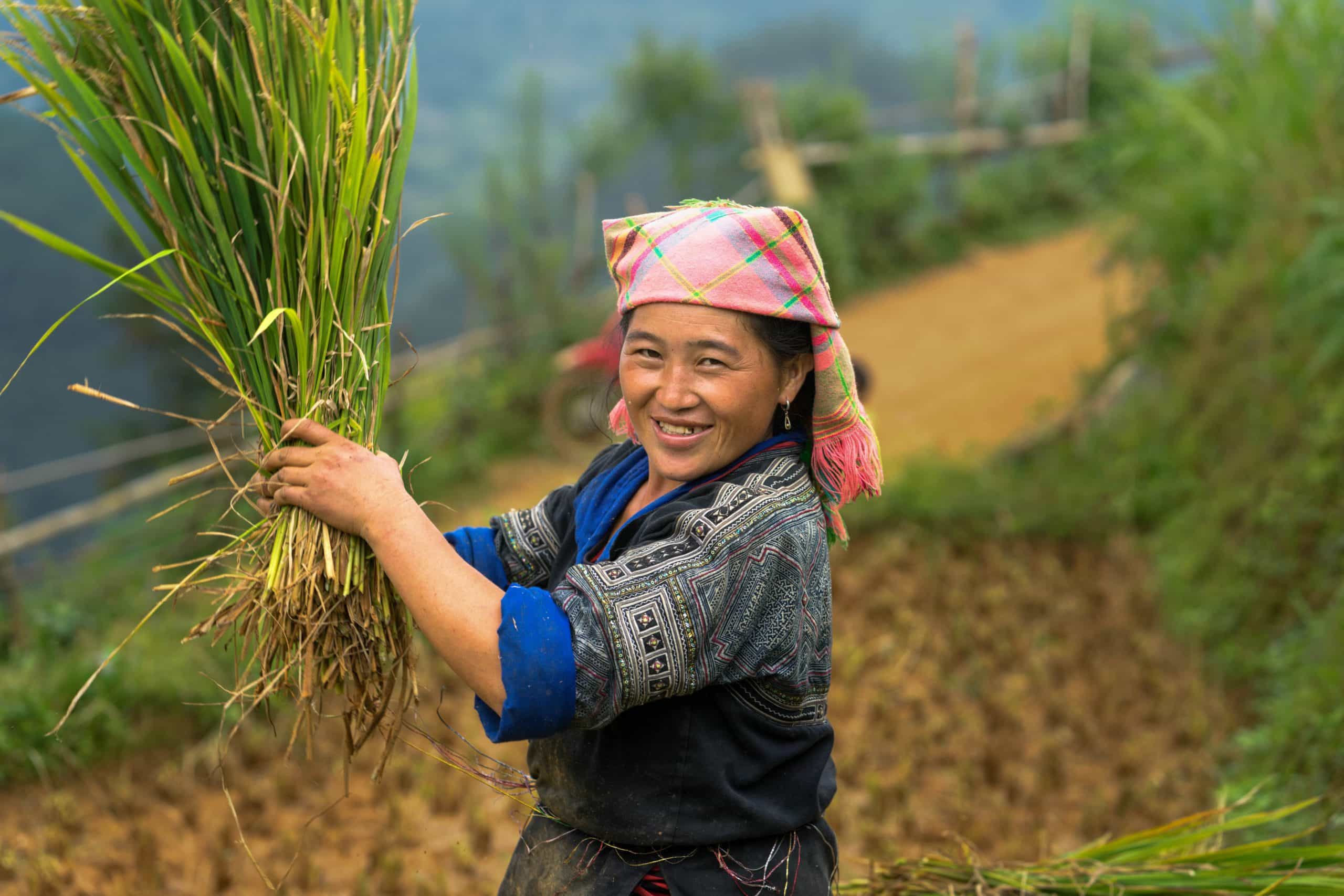
Today, the golden harvest on terraced fields looks somewhat different from decades past. Modernity has reached high-altitude villages, bringing machinery that saves time and eases physical labor after each harvest. In flatter fields and wide valleys, combine harvesters have gradually replaced some manual tasks. Yet on the steep terraces of northern Vietnam, machinery reaches its limits against the rugged landscape. While technology speeds up threshing, cutting, and bundling, transporting loads down mountain slopes to drying yards still depends largely on human endurance. The image of farmers patiently walking the steps of the terraces with heavy loads on their shoulders remains an enduring symbol of the mountain harvest.
Those shoulders are rarely alone. A father leads the way, followed by the mother, and then the children old enough to carry lighter bundles. The whole family forms a long line, moving like a slow stream as they carry the golden harvest from the fields to the village. Relief flickers across sun-tanned faces. The heavy loads are finally set down. Fatigue lingers, yet yields to a profound sense of peace as grain stores grow fuller day by day. Ultimately, the golden season resides not only in the extensive fields, but also upon shoulders that have carried an entire year of hope. It is the simple joy of farmers who, through their own labor, add to the majestic beauty of Vietnam’s mountains and forests.