Story: Nguyen Phuoc Bao Dan
Photos: Nguyen Phong
Across Hue’s royal monuments, fragments of porcelain and colored glass reveal the extraordinary craftsmanship of a bygone era.
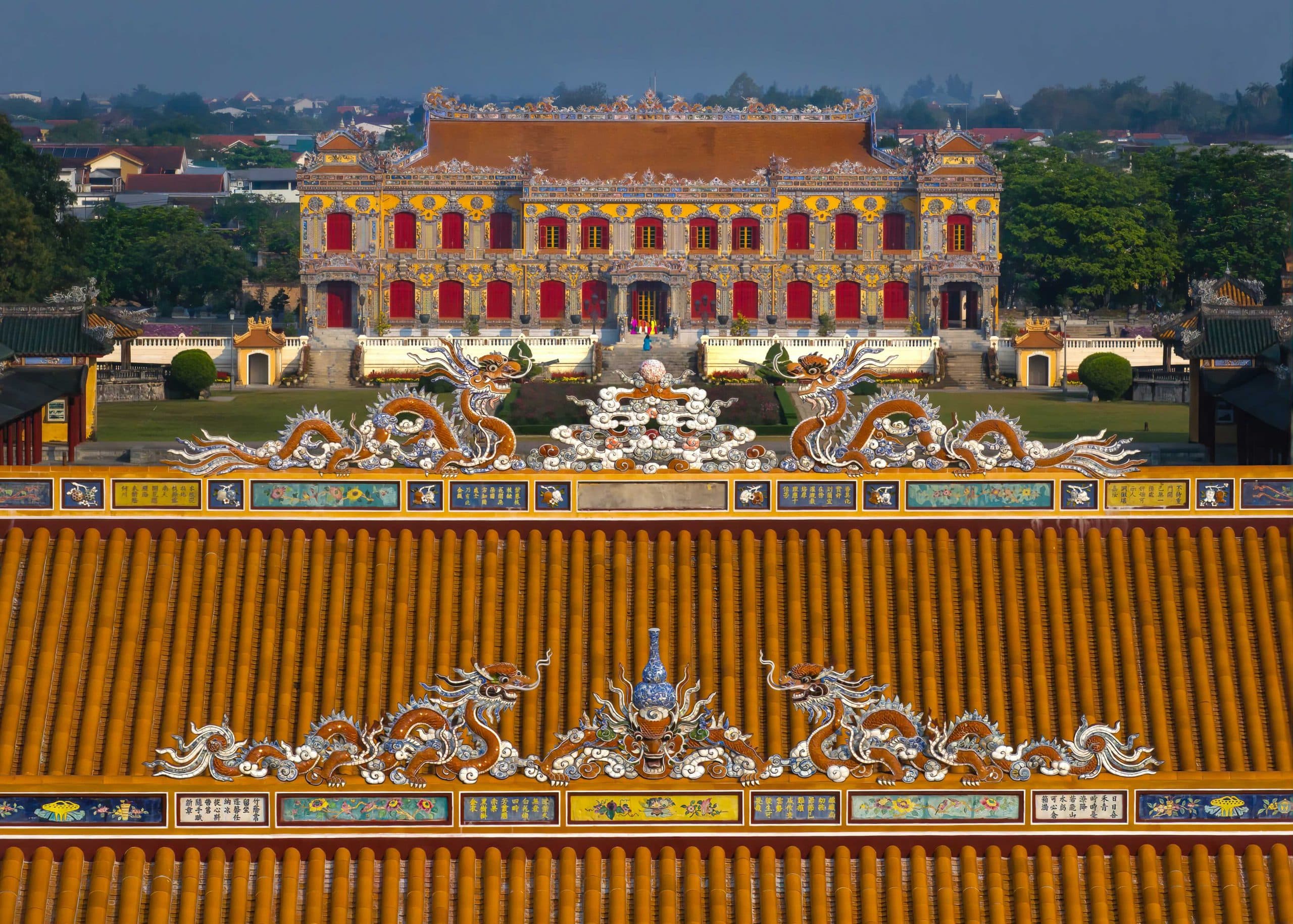
Upon entering the Imperial Citadel of Hue, surrounded by ancient palaces and royal pavilions, visitors are immediately struck by the site’s opulence and architectural splendor. The rigid silhouettes of these monumental structures are softened by vibrant porcelain mosaics, both inside and out. It is no exaggeration to say that artisans used creative techniques to turn shards of broken ceramics and colored glass into artworks that evoke the very soul of the royal capital.
Masterpieces of an era
In the early decades of the 20th century, as encounters with Western civilization intensified, new architectural works reflecting the spirit of the modern era emerged across Hue’s royal capital. These structures are closely associated with Emperor Khai Dinh (1916 to 1925), the 12th monarch of the Nguyen Dynasty, who sought to harmonize East and West, tradition and modernity, across multiple realms.
Located along the An Cuu River, An Dinh Residence was established in 1902 by Nguyen Phuc Buu Dao, who later became Emperor Khai Dinh. In 1917, after ascending the throne, the emperor remodeled the residence into a modern palace. He later bestowed it on Crown Prince Vinh Thuy, the future Emperor Bao Dai, as his residence before his coronation.
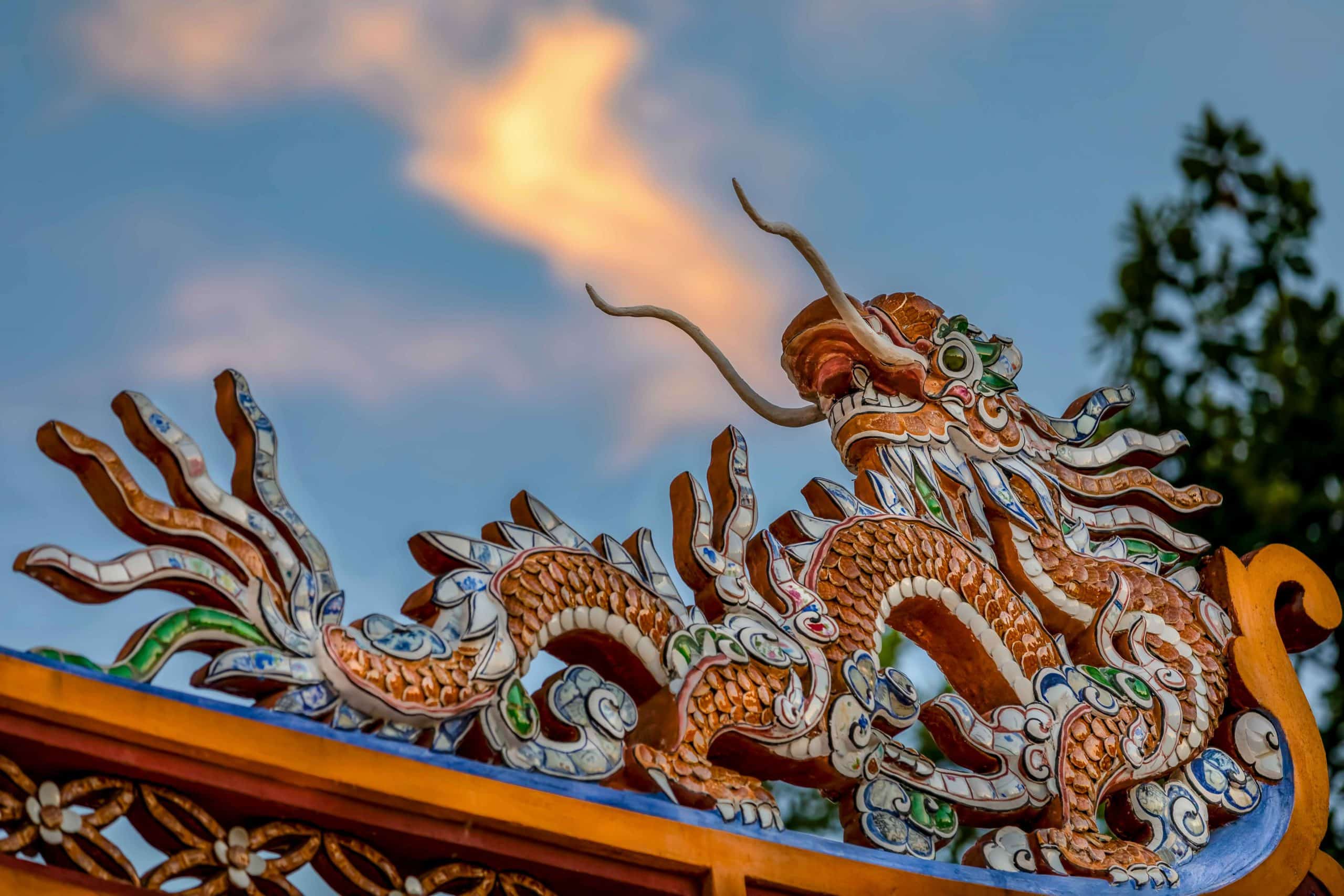
An Dinh Palace is a quintessential Hue landmark, combining Western architectural design with traditional decorative porcelain mosaics. From the Tam Quan Gate and Trung Lap Pavilion to the Khai Tuong Building, elaborate ceramic relief patterns adorn the surfaces, including two imperial poems penned by the emperor on the Khai Tuong Building’s facade. Here, locals often recall Cuu Tu Dai, a magnificent royal theater of which only the foundation remains today. Its mosaic craftsmanship reached breathtaking heights, featuring classical motifs such as carps leaping over the dragon gate, the five blessings, a hundred longevities, and the five qilins. Presenting these deeply Eastern motifs to Western guests served as a proud assertion of national cultural identity.
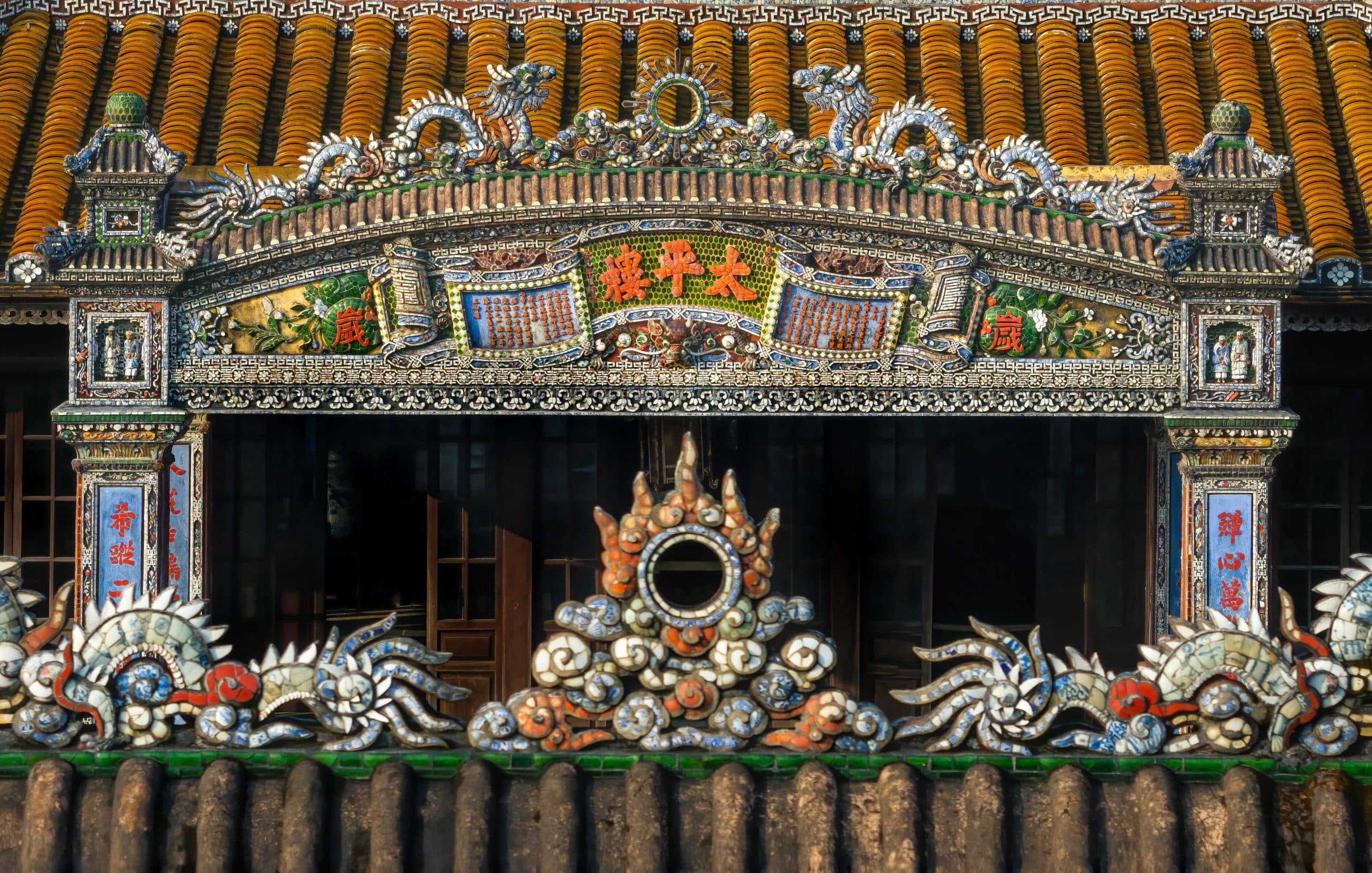
Across the Huong River from An Dinh Palace, nestled within the majestic Imperial City, Thai Binh Lau (the Royal Library) stands amid a quintessentially Eastern landscape of traditional timber-frame houses, pavilions, terraces, royal gardens, and covered corridors. In 1919, Emperor Khai Dinh commissioned the library on the site of the former Thanh Ha Thu Lau (the Writing Pavilion). A tranquil place to read and rest, it is striking for its seamless integration of traditional Hue timber-frame architecture and porcelain mosaic artistry within a single structure.
Exquisite mosaic designs extend across the Front Hall, Main Hall, and Rear Hall. These range from a horizontal board inscribed with “Thai Binh Lau,” two imperial poems, and didactic couplets, to rooftop and eave ridge motifs depicting two dragons honoring a yin-yang symbol, the divine turtle bearing the sacred cosmic diagram, qilins, and phoenixes. Most notably, the gable decoration depicts the classical motif of three elders exchanging wishes for longevity, conveying royal aspirations for the endurance of the dynasty and imperial lineage.
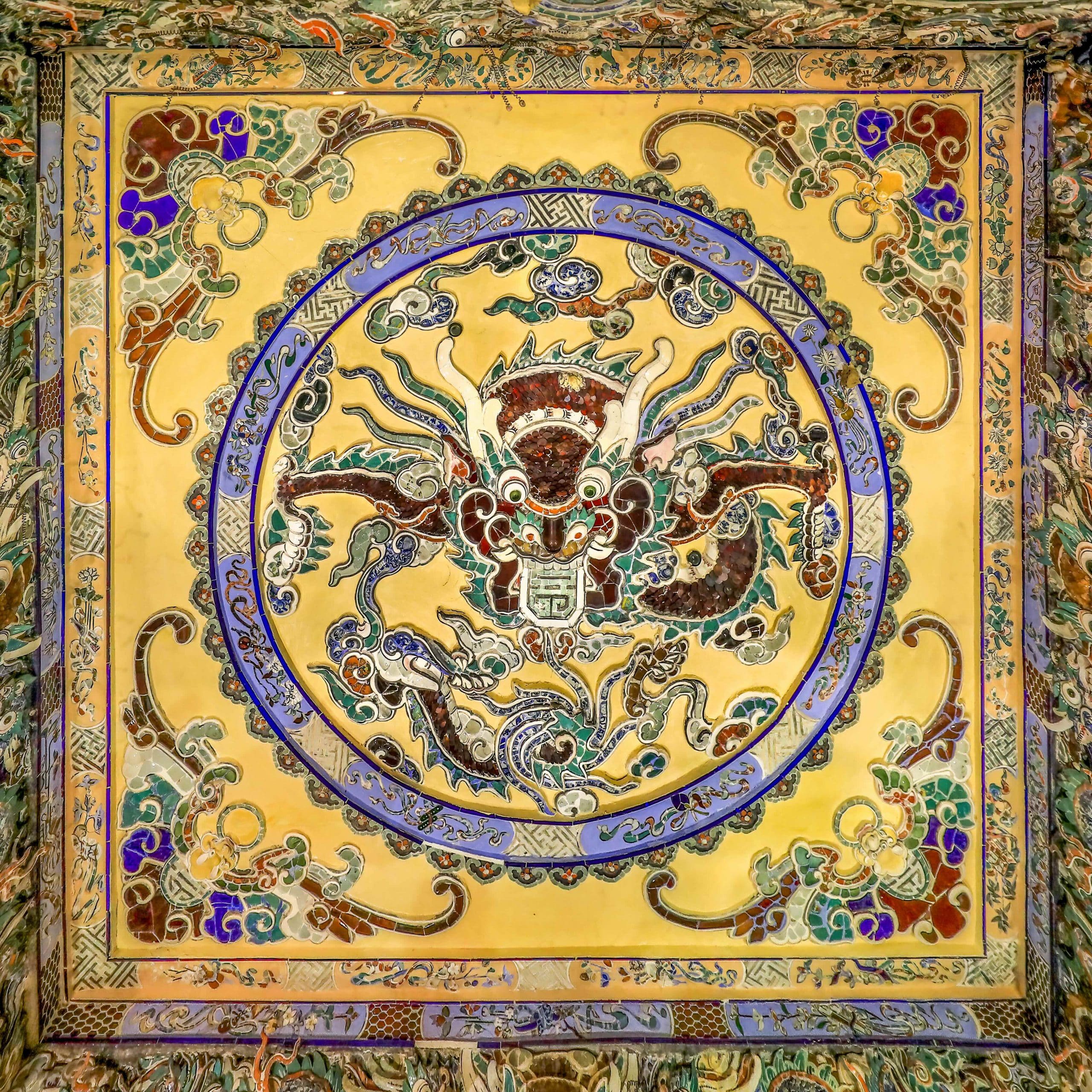
Elsewhere in the Imperial Citadel, landmarks such as Kien Trung Palace, Truong An Gate at Truong Sanh Palace, and the Chuong Duc and Hien Nhan Gates were newly constructed or restored during Emperor Khai Dinh’s reign. Together with Ung Tomb, Emperor Khai Dinh’s mausoleum on Chau Chu Mountain southwest of the imperial city, these sites remain remarkable testaments to the height of porcelain mosaic artistry.
Art born from broken shards
Fragments of seashell, coral, and slate were among the earliest decorative elements used on folk dwellings. Over time, this practice developed into the porcelain and ceramic mosaic technique of Dang Trong (Southern Vietnam) under the Nguyen Lords, as recorded in numerous historical texts. Yet it was during the reign of Emperor Khai Dinh that the technique reached its height, marking an important period in the history of Vietnamese fine arts.
Names associated with these landmark works include master craftsman Nguyen Van Kha, Luong Quang Duyet (Ky Duyet), and Cuu Sung, who worked with teams of artisans to carefully break precious porcelain and colored glass. They meticulously cut, shaped, ground, and assembled the fragments into decorative designs, then inlaid them into architectural surfaces using a special compound. The adhesive was made from precise proportions of oyster-shell lime, dodder vine, boi loi wood, sugarcane molasses, traditional do paper, and plant fibers, all pounded into a smooth, viscous paste that held the fragments in place.
These shattered fragments were never arranged at random across a surface. Instead, they formed deliberate compositions that used the porcelain pieces’ original curves, shapes, and painted patterns to create dynamic, sculptural murals in relief. The mosaic artisans’ skill is evident in the seamless joints and harmonious colors guided by the Eastern concept of the Five Elements, in which yellow, associated with the Earth element, symbolized imperial sovereignty.
Through their skill, the artisans transformed rigid shards of ceramic and colored glass into supple, fluid images. They rendered sinuous dragons, phoenixes, qilins, dragon-horses, and sacred turtles alongside grapevines, playful squirrels, and classic ornamental scenes drawn from Eastern lore.
When Vietnam’s monarchy ended, celebrated imperial artisans dispersed across the country. The art of porcelain mosaic once again returned to folk life, adorning communal village architecture. Decades later, as conservation efforts gained momentum after the Complex of Hue Monuments was inscribed as a UNESCO World Cultural Heritage site in 1993, new generations of master artisans revived these traditional techniques, restoring Hue’s aristocratic grandeur and recalling the splendor of its monarchical era.