Story: Truong Quy
Photos: Amachau
From sacred figures to revolutionary heroes, Hanoi’s public monuments reflect the history and memories woven into the city’s urban landscape.
Many street corners, city squares, and parks across Hanoi are remembered through their public monuments. As urban landmarks, these monuments have witnessed historical upheavals and preserved the memories of successive generations in a city full of symbolic sites. Honoring national heroes, cultural luminaries, and sacred figures, they help cultivate a shared communal consciousness.
Timeless echoes in Hanoi’s historic quarters
Some of Hanoi’s earliest public monuments were Catholic statues placed before churches in the late 19th and early 20th centuries. Their classical beauty harmonized with Hanoi’s elegant tree-lined streets. The most prominent is the statue of Our Lady, Queen of Peace, cradling the baby Jesus outside Saint Joseph’s Cathedral. Standing on a modest stone pedestal in a small square, the gilded bronze statue contrasts with the Gothic cathedral’s majestic, weathered gray facade, creating spiritual depth and harmony.
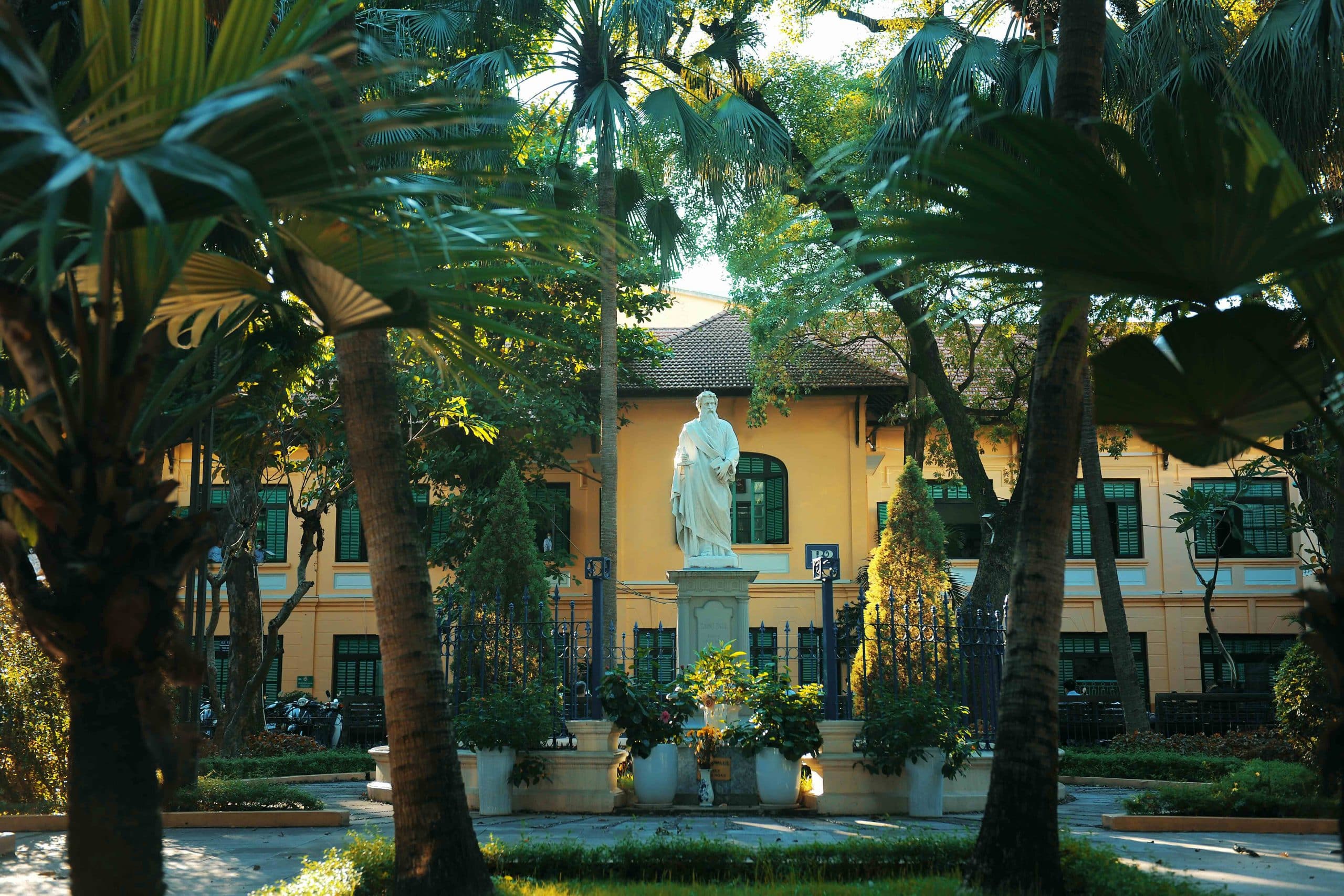
Another sacred sculpture with a monumental presence is the statue of Saint Paul on the grounds of Saint Paul General Hospital. Carved from white stone, with a contemplative expression and flowing robes that suggest motion, it stands out against broad palm fronds and yellow colonial buildings. Pure and unassuming, it offers comfort and serenity to recovering patients.
A prominent pre-1945 statue honoring a Vietnamese historical figure is the monument to King Le Thai To behind Nam Huong Communal House, overlooking Hoan Kiem Lake, erected in 1894. Depicting the king holding a sword pointed toward the water, it reenacts the legendary return of the magical sword to the Golden Turtle God, an enduring symbol of national identity. The monument sits within a carefully arranged architectural setting featuring ceremonial gates, a square pavilion, a pedestal column, and a rear decorative screen, integrating gracefully with Nam Huong Communal House to form a dignified, evocative space.
Enduring simplicity
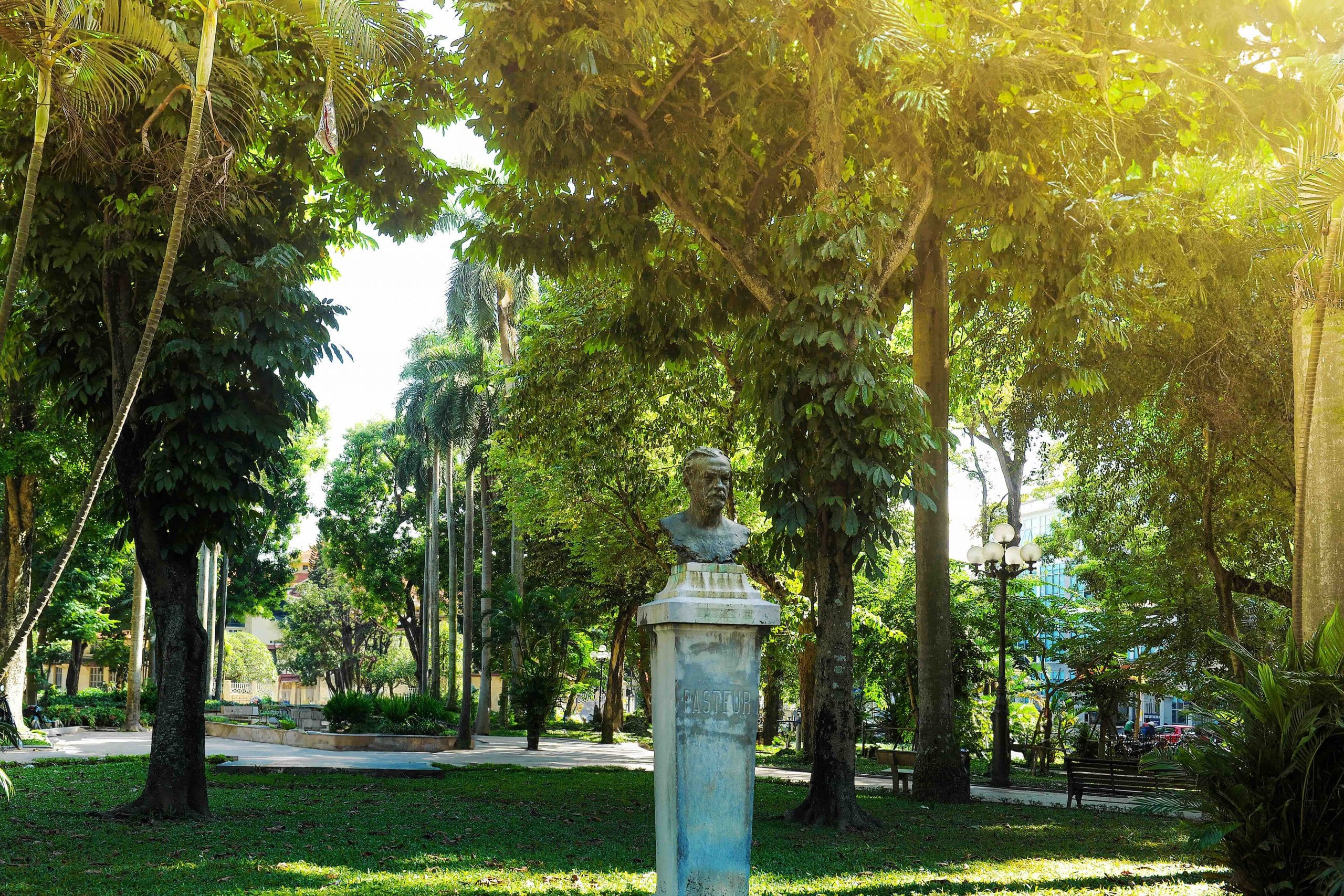
Some statues of notable figures take a modest approach, nestled quietly within public gardens. One example is the bust of scientist Louis Pasteur in the park bearing his name, facing the National Institute of Hygiene and Epidemiology. Honoring the pioneer of modern microbiology, the life-sized bronze bust rests atop a tapered square stone column inscribed simply with the word “PASTEUR.” The weathered bronze and muted blue-gray stone blend seamlessly into the lush greenery, flanked by royal palms lining the walkway to the Indochina-style institute.
Similarly, a bronze bust of Dr. Alexandre Yersin, Pasteur’s disciple who maintained close ties with Vietnam from 1890, stands in neighboring Yersin Park. The bust rests on a stone plinth facing the Institute of Hygiene and Epidemiology, an institution that inherited the Pasteur Institute of Hanoi’s historic medical legacy.
Honoring sacred sacrifices
The earliest monuments erected by independent Vietnam in the capital honored young revolutionary heroes, integrated into newly landscaped parks and gardens. Following the renovation of Thanh Nien Road and the garden fronting Quan Thanh Temple, a white concrete statue of Ly Tu Trong was erected. Featuring bold geometric forms, it conveys the valiant spirit of the 17-year-old hero amid lush trees beside West Lake. In Thong Nhat Park, a bust of Nguyen Van Troi honors his heroism during the resistance war against America. To commemorate the devastating losses of the 12-day B-52 bombing campaign in December 1972, a monument of a mother holding her child was erected on Kham Thien Street, built directly on the ruins left by the war.
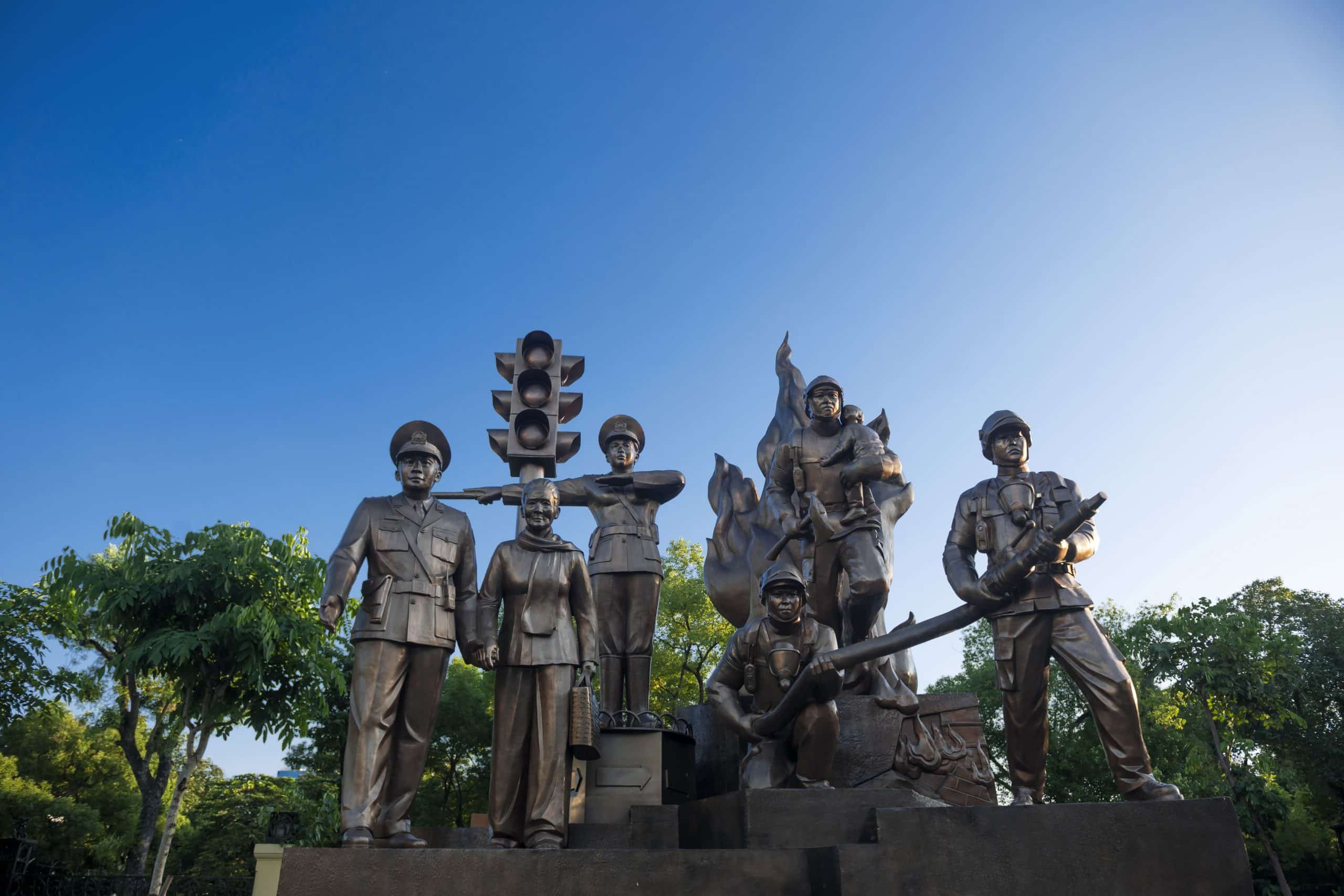
From the 1980s onward, public monuments became increasingly prominent in the urban landscape. To commemorate the 60-day opening battle of the National Resistance, a monument to the volunteer fighters was erected beside Ba Kieu Temple. Over the years, the three-figure sculpture became a familiar sight, but it was not until a monument on the same theme was inaugurated in Van Xuan Park in 2004 that Hanoi’s historical memory was fully represented north of the Old Quarter.
Monuments honoring national heroes and historical figures have also been erected in locations intrinsically linked to their legacies. Notable examples include the statue of King Ngo Quyen in Son Tay, the monument to national hero and cultural icon Nguyen Trai in Ha Dong, and the statue of King Quang Trung in Dong Da Cultural Park, commemorating his celebrated spring 1789 victory over invading Qing forces. These landmarks enrich the civic landscape, offering welcoming grounds for local festivals and cultural gatherings.
Dignity in everyday life
In 1985, a statue of V. I. Lenin, designed in the Soviet Union, was erected on the site of the former Agriculture Monument in Chi Lang Flower Garden, in front of the Hanoi Flag Tower. The mid-sized bronze statue depicts Lenin in mid-stride, his coat billowing behind him. It stands on a granite pedestal that widens toward the base, forming a triangular shape that draws the eye toward the Hanoi Flag Tower. The overall design echoes the park’s triangular layout, while a row of bauhinia trees interspersed with flamboyant trees behind the monument adds further visual interest.
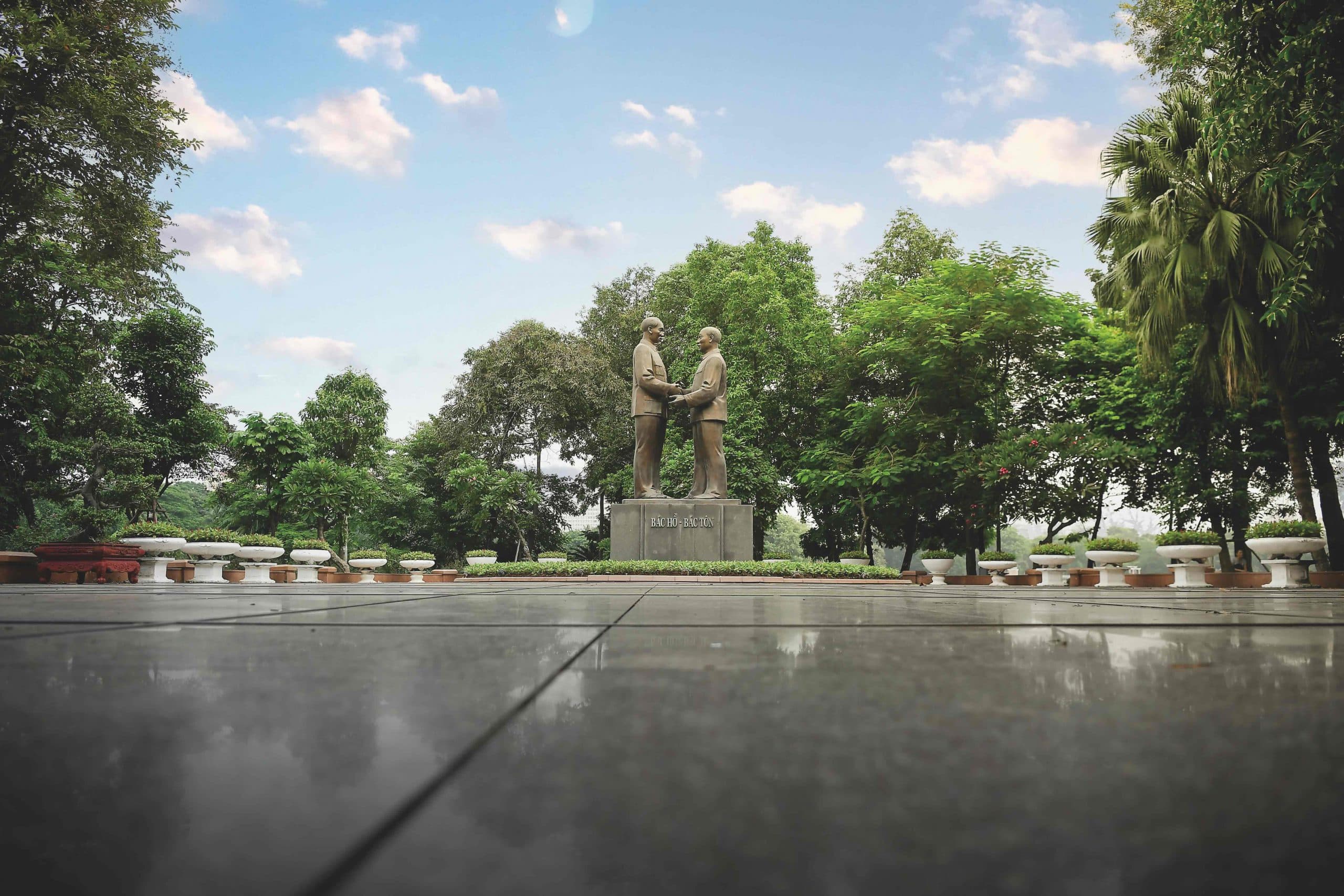
Despite the city’s profound connection with President Ho Chi Minh, aside from an earlier statue at the Ho Chi Minh National Academy of Politics, it was only in the 21st century that Hanoi erected a statue of Uncle Ho and Uncle Ton on an island in Thong Nhat Park, symbolizing the reunification of North and South. Another notable piece is a bronze statue of Uncle Ho at work, gifted by the Labor Party of Mexico and installed at the Presidential Palace. Also hailing from Latin America, a bronze bust of Cuban national hero and writer Jose Marti Perez rests gracefully upon a pink stone plinth in Tao Dan Park.
Near historic Ba Dinh Square on Bac Son Street stands the Memorial to Heroic Martyrs. Breaking away from conventional freestanding figurative statuary, the open-sided cubic monument evokes the curved roofs of a traditional temple. Without being overpowering, it conveys solemn elegance and quiet majesty. By Hoan Kiem Lake, erected to celebrate the millennial anniversary of Thang Long – Hanoi, the imposing statue of King Ly Thai To anchors the central garden, conversing with surrounding historical relics and serving as a gathering point on busy weekends, near the pedestrian zone.
Woven into the urban landscape, monuments enter Hanoians’ collective memory and serve as visual history lessons, anchoring sentiments built over generations. Over time, familiarity has turned these statues into cherished landmarks that blend with the rhythm of daily life as the city continues to evolve.