
Story: Truong Quy
Photos: Amachau
The Red River Delta formed through the geological forces and alluvial deposits of its dense river system. Over time, villages sprang up around bodies of water, giving rise to a wet-rice civilization deeply attuned to water’s rhythms. In this landscape, water pavilions (thủy đình) – their reflections shimmering in village ponds before temples and pagodas – enhance the overall harmony of the scenery.
Jewels among scenic sites
Water pavilions stand within bodies of water in front of ritual structures, acting as feng shui anchors and completing the spatial composition according to the principle of “leaning against mountains, facing water.” Structures align sequentially along a central axis, creating the sacred path.
At the axis’s lowest point sits a semi-circular or square pond, where the water pavilion marks the starting point. Beyond the water lies a broad forecourt that serves as a viewing space and venue for communal village festivals. A ceremonial gate – or triple-entrance gate – leads into the temple or pagoda. The space then rises gradually toward the rear sanctuary, home to deities or Buddha, and culminates with a mound or mountain behind.
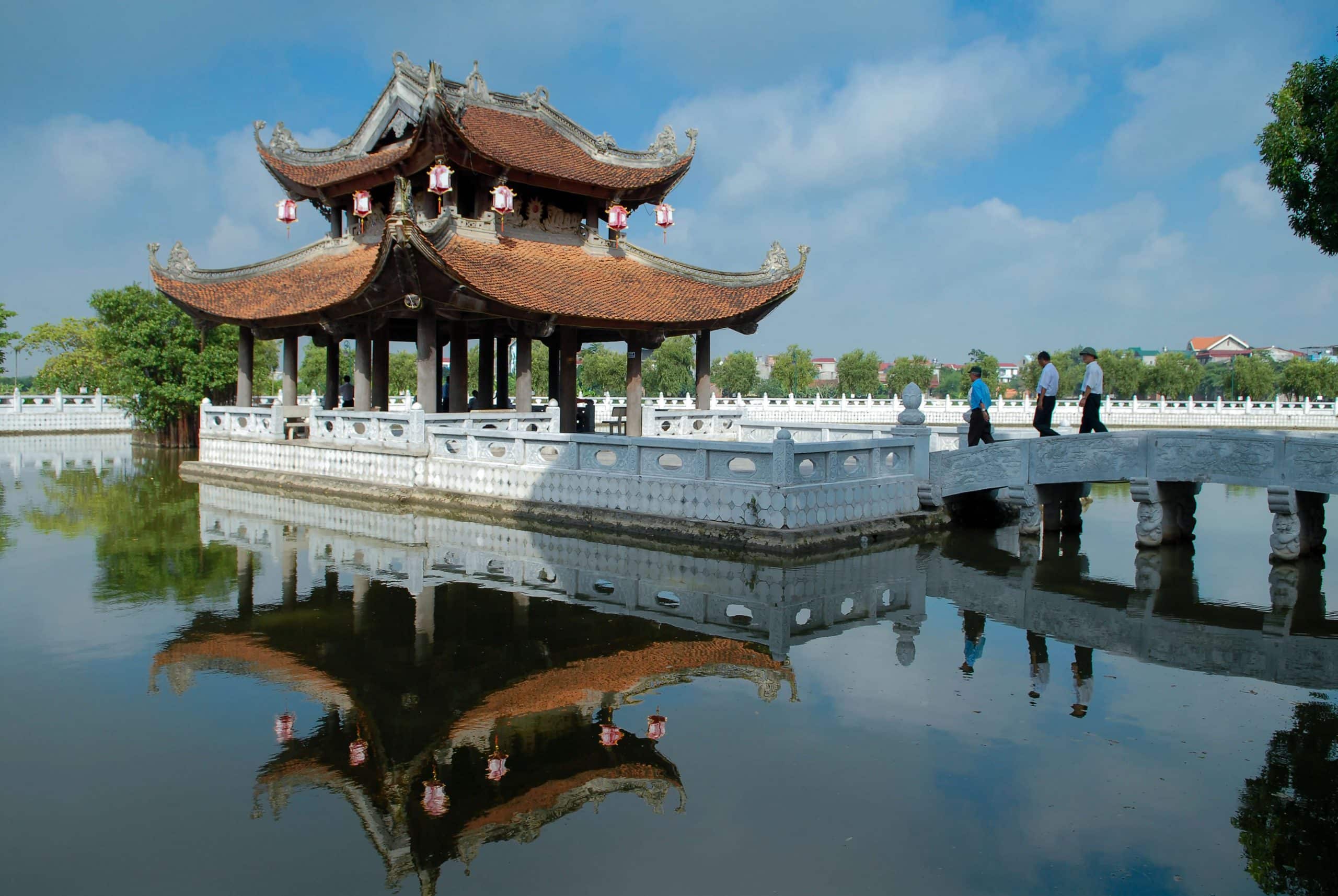
A water pavilion is typically a square structure, open on all four sides, with a two-tier tiled roof and eight curved eaves resembling a blooming lotus. The pavilion itself also functions like an artificial mountain, evoking the paired motif of mountain and water within the delta landscape. Many water pavilions have evolved into refined and symbolic exemplars of traditional northern Vietnamese architecture.
A unique performance chamber for water puppetry
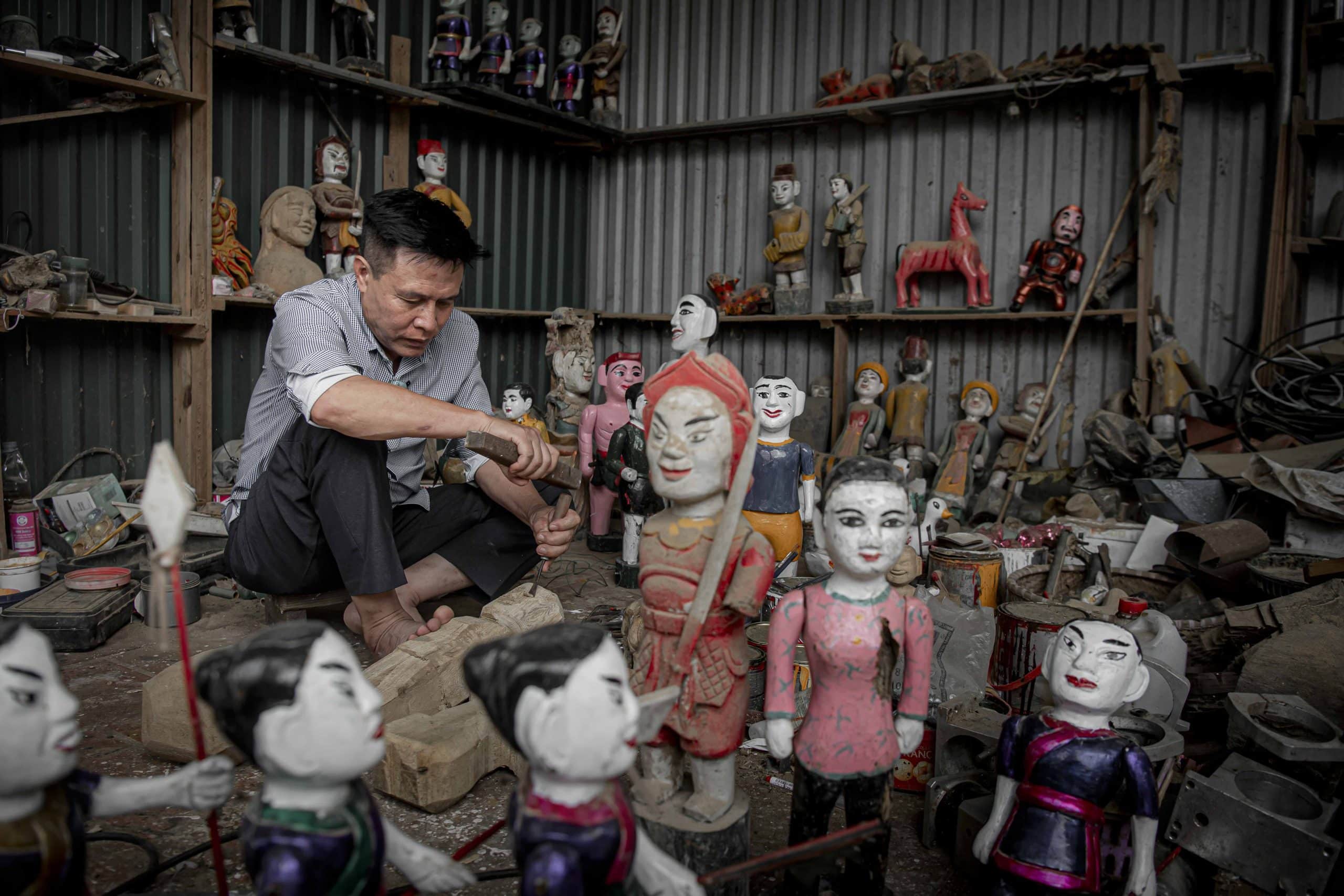
Water pavilions are best known for their link to the art of water puppetry (múa rối nước). An inscription from 1121 records performances in the Ly dynasty’s royal court, depicting rippling waves, a golden turtle bearing three mountain peaks, and immortals emerging from a cave’s mouth. With deep roots, water puppetry blends music and literature into shows that portray everything from mythological tales and battles to scenes of riverine daily life. Puppets row boats, plow fields with buffalo, or catch fish – all infused with humor and joy.
On performance days, the water pavilion serves as the stage or puppet chamber. A curtain is hung as a backdrop, concealing the artisans who stand in the water, while allowing them to observe both the puppets and the audience. Water forms an integral part of the show, masking the control system of poles, which are hidden below the surface. The puppets emerge from behind the curtain and move beneath the surface before emerging or being revealed as the curtain is slightly parted.
In the heart of the delta, traditional water puppet pavilions display refined Vietnamese craftsmanship. Located by the Duong River dike in the former Kinh Bac region, Giong Temple (Phu Dong) faces a body of water. At the pond’s center, a two-tier, eight-roof water pavilion rises. Layered beams and brackets form its timber frame, adorned with carvings of the four sacred animals and Later Le-style chrysanthemum motifs. A bridge extends from the shore to an open platform in front of the pavilion, which serves as a venue for folk performances and water puppetry shows during the annual Giong Festival, held on the ninth day of the fourth lunar month.
Researchers have identified a “golden ratio” that allows the structure to fit harmoniously within a circular composition, further enhanced by the shade of a large banyan tree by the dike, like a flower embraced by the green curve of the embankment. Nearby, the water pavilion of Nanh Pagoda (Phap Van Tu, Ninh Hiep) likewise completes the sacred westward-facing axis, following the Buddhist principle of orientation toward the Western Pure Land.
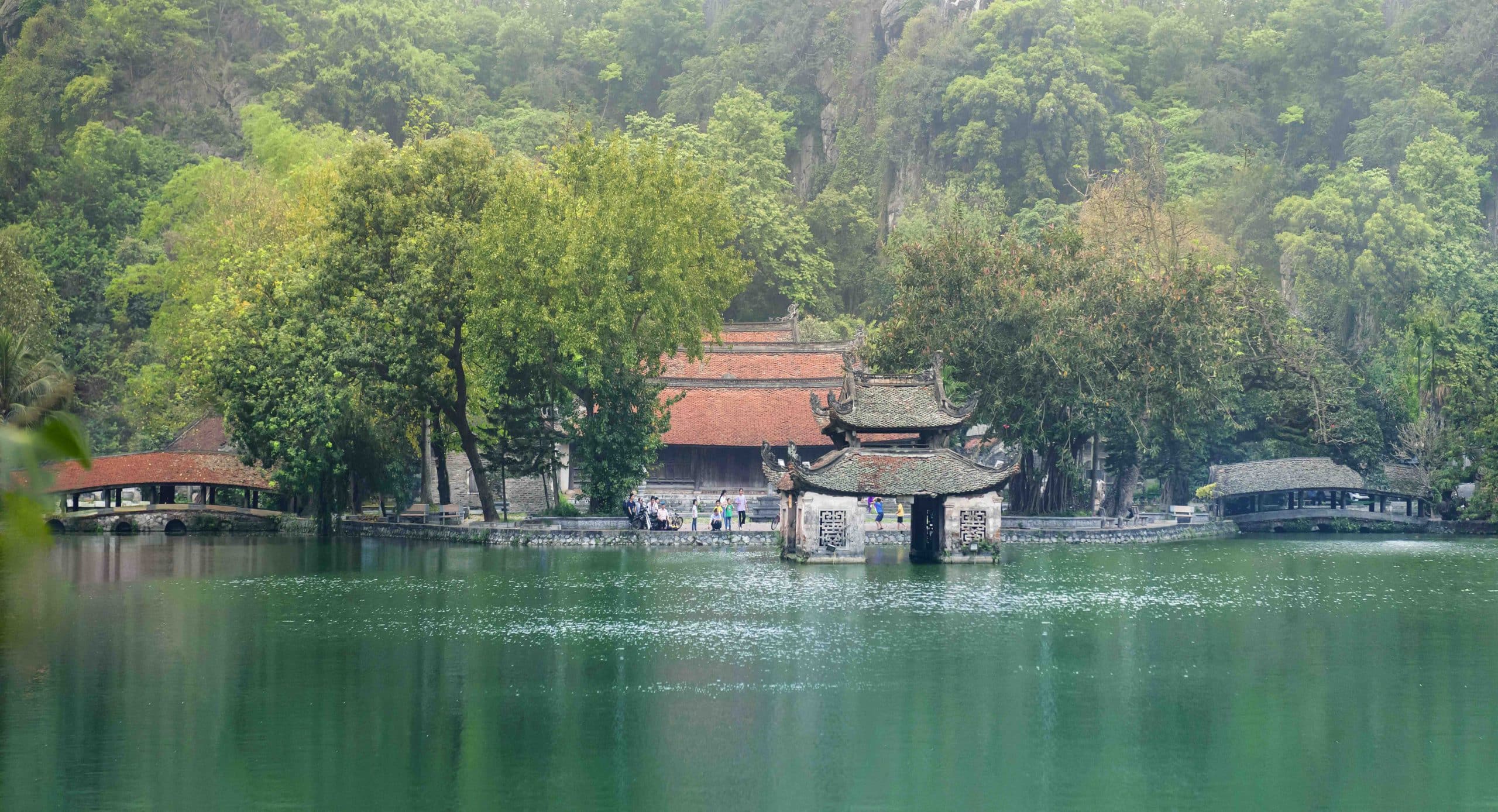
In the Doai region (formerly part of Ha Tay province, now Son Tay town, Hanoi), the water pavilion at Thay Pagoda (Thien Phuc Tu) is an iconic image of Vietnamese cultural tourism. Set before the ancient pagoda, the pavilion stands at the center of Long Tri Lake, as if rising from the waters. It dates from the 17th century. The complex is arranged in the form of a dragon holding a pearl. During the Thay Pagoda Festival, held from the fifth to the eighth day of the third lunar month, water puppetry takes center stage. Nearby lies Hoang Xa Cave, where Hoa Van Pagoda and a modest water pavilion are reflected in a pond full of lotus blooms in the summer, connected by a three-arched stone bridge.
Heritage on the water
Water pavilions are closely linked to traditional water puppet villages. In Thach That in the Doai region, three such villages stand out: Ra, Chang Son, and Thach Xa. Chang Son, famous for its carpentry tradition, features a water pavilion before its communal house – a model for restored pavilions, now expanded with side sections to enlarge the performance space. In the former Son Nam region, notable villages include Te Tieu (My Duc, Hanoi) and Rach (formerly Nam Truc, now in Ninh Binh). Along the Red River’s left bank, puppet guilds thrive in Dong Ngu (Thuan Thanh, Bac Ninh), Thanh Hai, Hong Phong (formerly Hai Duong, now Hai Phong), Nhan Hoa (Hai Phong), and Nguyen Xa (formerly Thai Binh, now Hung Yen). Dao Thuc village (Dong Anh, Hanoi) exemplifies heritage preservation with its large water pavilion, perfectly suited for traditional performances.
Water pavilions serve not only as stages for water puppetry but also as venues for folk activities such as boat races and swimming competitions, as seen at Dam (Tay Tuu, Hanoi) and Trieu Khuc (Hanoi). Now within the city limits, both remain vibrant, as captured in the old folk verse: Boi Dam, ruoc Gia, hoi Thay / Vui thi vui vay chang tay ra La. (Dam’s boat races, Gia’s procession, Thay’s festival. Joyful as they all are, none rival the revelry of La.)
In the Kinh Bac region, renowned for quan ho folk singing, water pavilions at sites such as Den Do (Tu Son), Lim, Lung Giang (Tien Du), and Hoai Trung (Lien Bao) serve both as architectural focal points and as venues for viewing performances, evoking the old verse: “Seated by the side of the boat… the moon reflected on the water – the longer one gazes, the more enchanting it becomes.”
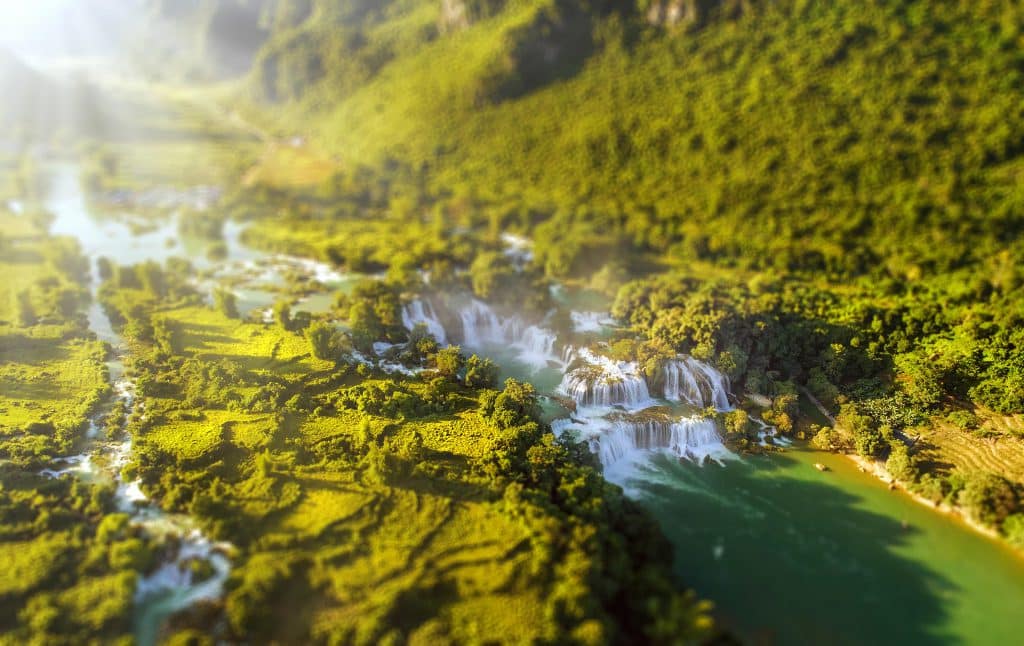
In recent years, scenic sites have begun reconstructing water pavilions, such as at Vu Lam Palace in the Trang An Landscape Complex. Brownish-purple tiled roofs rise gently over the vast emerald water and layered mountains, completing the scene like the final brushstroke on a beautiful landscape painting. Though modest in form, these structures contain the long-standing cultural heritage of the Viet people.