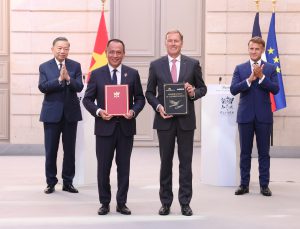

As Vietnam Airlines prepares for its next phase of fleet expansion, the national flag carrier is continuing to strengthen its partnership with CAE Inc. in aviation training, simulation technology and the operation of training systems. The partnership is being advanced as part of the State visit to Canada by General Secretary and President To Lam.
The growing demand for skilled aviation professionals is placing increasing pressure on the industry across the region. Airbus forecasts that the Asia-Pacific region will require more than 1.06 million new aviation professionals by 2044, while Boeing estimates that Southeast Asia alone will need approximately 258,000 additional aviation personnel by 2045. These projections underscore the growing importance of recurrent and aircraft-type conversion training, as well as the development and retention of highly skilled professionals, as airlines seek to keep pace with the rapid expansion of their fleets.

Under a memorandum of understanding exchanged by Vietnam Airlines and CAE during the State Visit to Canada by General Secretary and President To Lam, the two sides will strengthen cooperation in aviation personnel training; the maintenance and technical support of flight simulation systems; and the research and application of advanced simulation technologies and solutions. They will also explore opportunities to invest in additional simulation infrastructure to support Vietnam Airlines’ fleet development plans.
Mr. Le Truong Giang, Member of the Board of Directors of Vietnam Airlines, said: “To operate a modern fleet effectively, an airline must stay ahead of its training needs. Our partnership with CAE enables Vietnam Airlines to take a more proactive approach to developing a highly skilled workforce, strengthen our in-house capabilities in simulation technology, and prepare for our fleet development plans in the next phase. It also represents a deeper level of cooperation between Vietnam and Canada in aviation, technology and specialized training.”
For an airline, adding new aircraft is only one part of the growth equation. It must also prepare pilots, flight instructors, examiners, technicians and other operational personnel to meet international standards. These professionals require extensive training, accumulated experience and regular proficiency checks under rigorous procedures. With flight simulation systems available in Vietnam, Vietnam Airlines can reduce its reliance on overseas training centers, lower training costs, minimize the time pilots spend away from line operations, and gain greater flexibility in crew planning and deployment.
Vietnam Airlines and CAE began their partnership in 2012, when the airline invested in its first CAE-manufactured A320 flight simulator, designated VN001. In 2016, the two parties signed a cooperation agreement to install and commission three additional next-generation simulators at the Vietnam Airlines Flight Training Center: one Airbus A320, one Airbus A350 and one Boeing 787 simulator. The expanded simulator fleet enabled the Center to meet training requirements for both narrow-body and wide-body aircraft.
Bringing aircraft-type conversion training for these key aircraft types in-house, particularly for advanced aircraft such as the Airbus A350 and Boeing 787, has generated significant economic benefits for Vietnam Airlines.
The partnership with Vietnam Airlines has also enabled CAE to expand its training presence in Southeast Asia to Vietnam, following Malaysia and the Philippines. Since 2017, the CAE simulation systems based at the Vietnam Airlines Flight Training Center have been operated to support the training needs of Vietnam Airlines as well as customers in Vietnam and international markets.
For Vietnam Airlines, the simulator systems deliver tens of thousands of training hours each year, supporting recurrent, aircraft-type conversion and upgrade training programs for approximately 2,500 pilots. In 2024, Vietnam Airlines and CAE extended their cooperation on the operation of the A350 and B787 simulators through the end of 2033.
From the first flight simulators introduced in Vietnam to the advanced simulation systems now in operation, the partnership with CAE has become an integral part of Vietnam Airlines’ efforts to build deep, in-house training capabilities. As pilots and highly skilled technical personnel become increasingly critical to airline operations, greater in-house control of training technology will help Vietnam Airlines strengthen its ability to operate safely and reliably, while contributing to the competitiveness of Vietnam’s aviation industry.