Story: Nguyen Phuoc Bao Dan
Photos: Nguyen Phong
As we enter the Year of the Horse, let’s examine horse designs in the decorative arts of Hue.
When the shaping techniques of Hue’s artisans culminate in the refinement of a distinctive decorative motif – the Horse – the familiar form of this everyday animal transcends its earthly roles and steps into the realm of timeless spiritual symbolism.
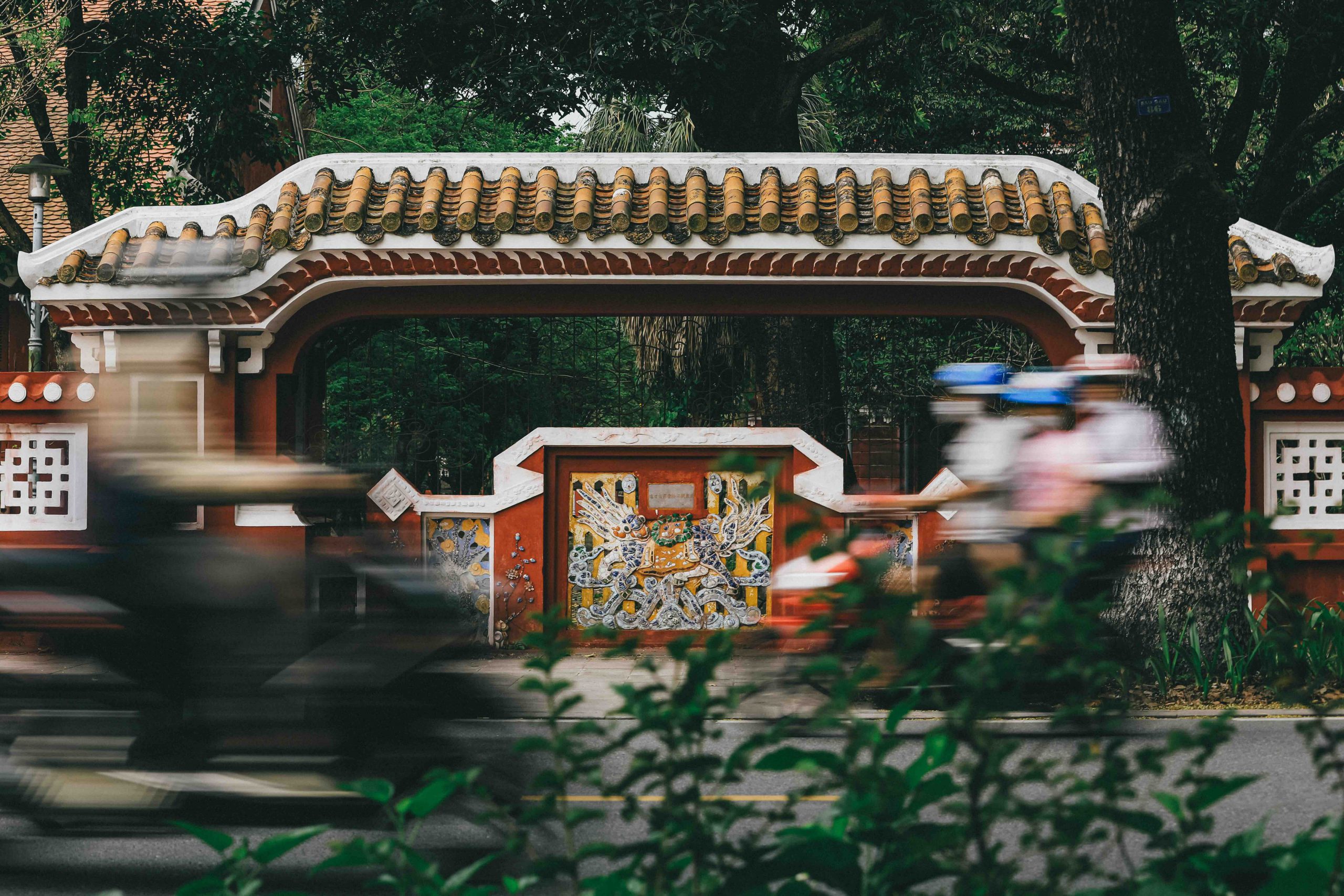
Throughout Hue, from folk architecture to imperial structures, the image of the horse appears everywhere in a multitude of compositions and materials. It might be stone horse statues in the ceremonial courtyards of mausoleums; wooden horse statues in temples and shrines; long ma (dragon-horse) reliefs embossed with lime mortar and inlaid with porcelain on ceremonial gates, screens, and entryways; plaster or papier-mâché horse statues for worship; or images on the woodblock prints of Sinh village (Lai An).
Whether in the royal court or among the folk, although the artistic techniques differ in each setting, one can see that the form and demeanor of the horse seem to freeze in a moment into specific decorative styles, conveying the artisan’s intent and bearing the distinct essence of Hue.
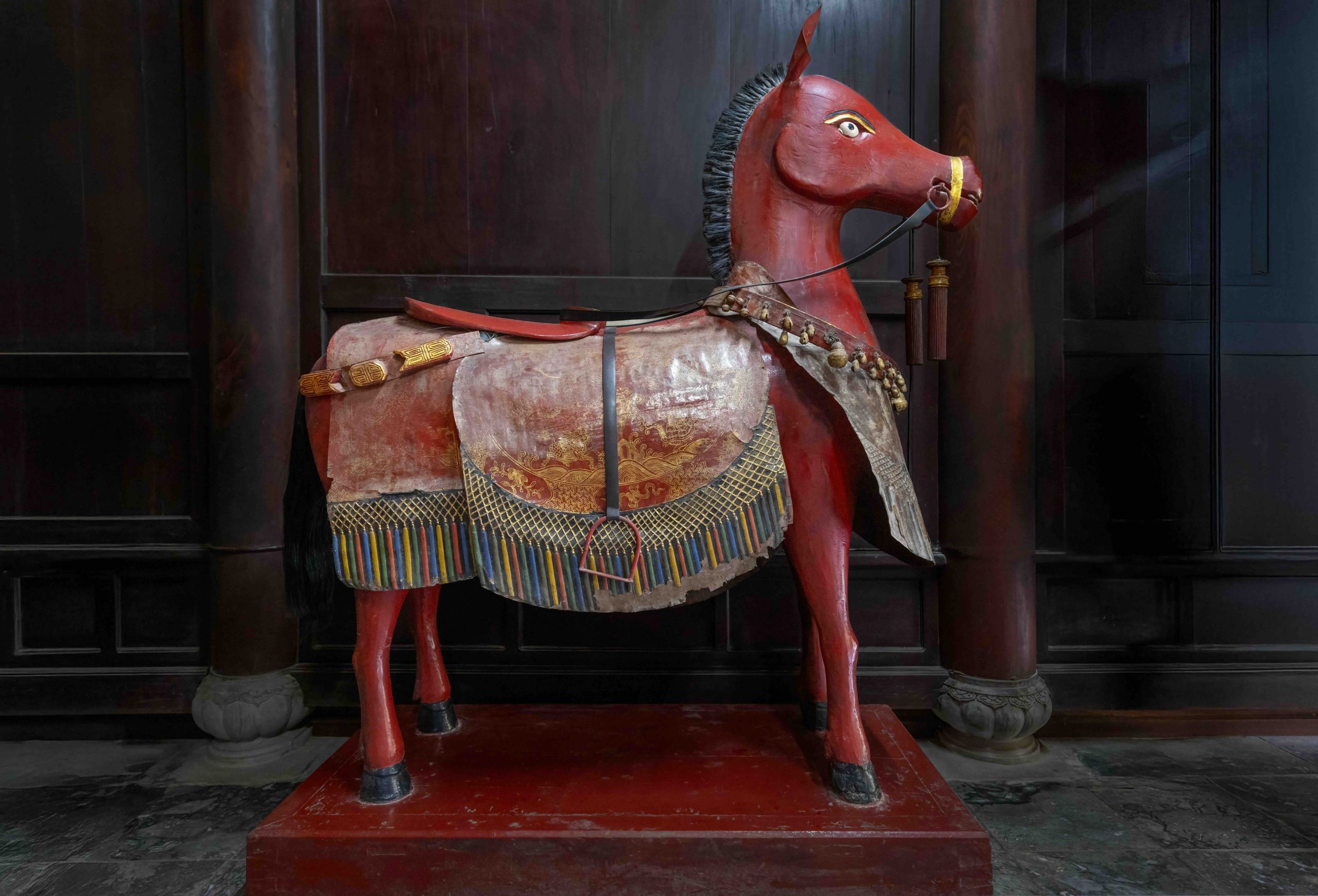
In the mausoleums of the Nguyen kings such as Gia Long, Minh Mang, Thieu Tri, and Tu Duc, it is not difficult to encounter horse statues crafted from stone, fully saddled and bridled, standing stoically in attendance at the ceremonial courtyard as if remembering their departed masters. Then, in that same posture but in a different material, statues of wooden horses painted white or red are often placed on either side of altars dedicated to the White Horse Deity (Bach Ma), the God of War (Guan Yu), Tran Hung Dao, or at Tu Hieu Pagoda, where the Quang Hieu Hall worships General Le Van Duyet – a meritorious official founding the Nguyen Dynasty.
In the beliefs of the people of Hue, in certain realms between heaven and earth, and between the living world and the underworld, deities often use horses as mounts for attendance and for carrying out their missions; thus, since ancient times, the people of Hue have offered horse statues to show their respect. In shrines and worship spaces within home gardens, it is not difficult to see horse statues made of plaster or papier-mâché. On important holidays, the people of Hue also often burn votive offerings for the spirits, which include sets of horses, boots, hats, robes, and bows and arrows. Also within spiritual life, in the past, people often used the “Six Livestock” prints (buffalo, horse, cow, pig, dog, goat, chicken), printed in the woodblock style of Sinh village (Lai An), to worship at animal stables, praying for the peaceful protection of their livestock.
It is a vivid and diverse world of symbols, but perhaps the most popular is the screen depicting the Long Ma (Dragon Horse) and the horse-themed decorative styles on the ceremonial gates in Hue.
The Long Ma, a creature stepping out of Chinese mythology, is a sacred mascot converging the good qualities of the dragon, the unicorn (ky lan), and the horse. The form of this creature is described as a combination of a dragon’s horns and mane, a musk deer’s body, an ox’s tail, a wolf’s forehead, a unicorn’s scales, and a horse’s legs and hooves. This sacred image is often embossed with porcelain shards and lime mortar or painted on screens used to shield against wind and ward off evil spirits for Hue’s architecture. Its pinnacle is its use as the logo of the Hue Festival, modeled after the most famous Long Ma screen in Hue, built in the 8th year of Thanh Thai (1896) at Quoc Hoc Hue High School.
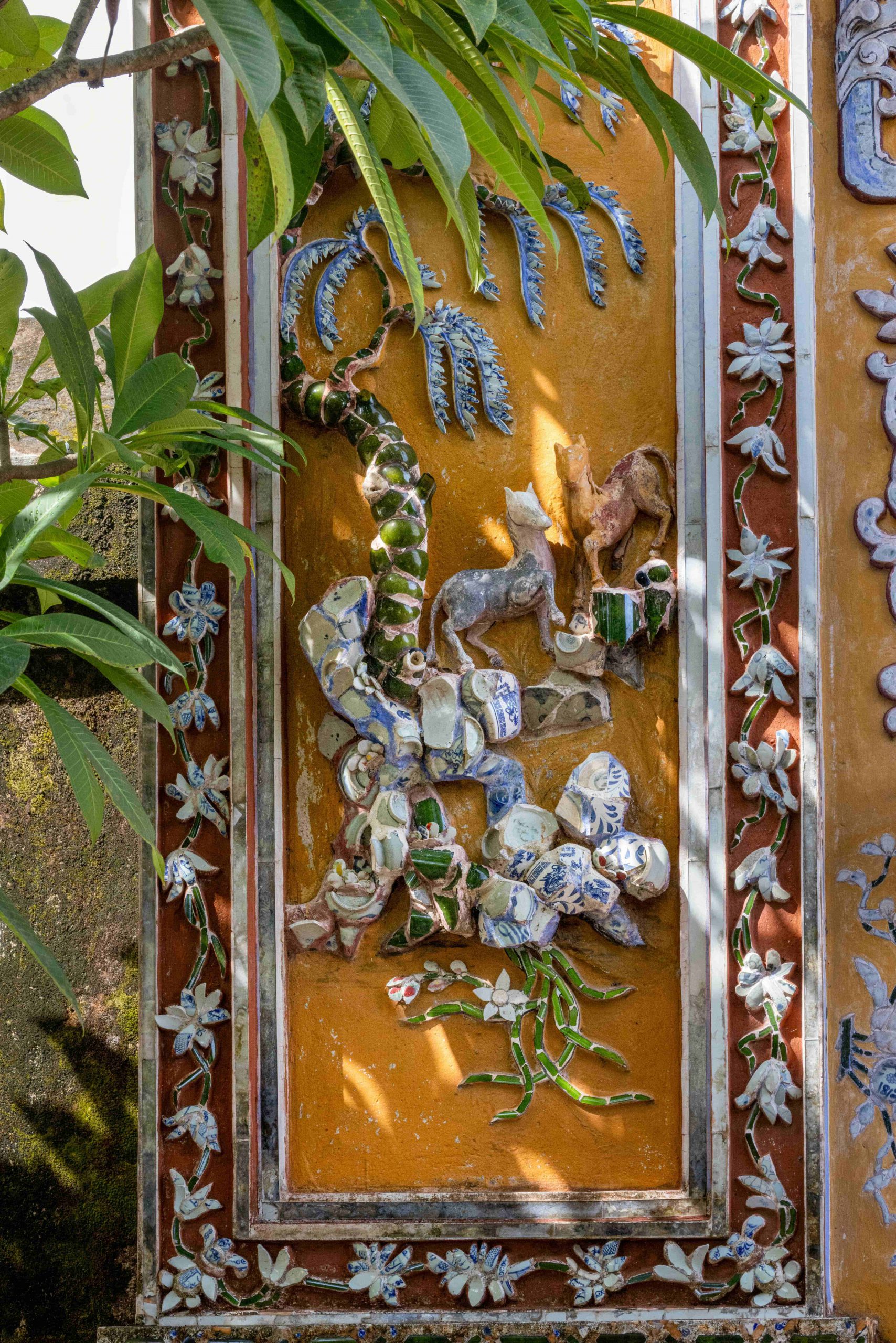
On ceremonial gates within the Hue Imperial Citadel, such as Duc Khanh Gate, Hung Khanh Gate, Truong An Gate, Truong Sanh Palace, or the Tu Phuong Vo Su Pavilion, many decorative styles related to the horse are expressed through lime mortar and porcelain mosaic. These can be the characteristic Willow-Horse motif (Willow tree – Horse) or the Eight Immortals Riding Beasts (Eight immortals riding a dragon, unicorn, turtle, phoenix, peacock, elephant, horse, and crane). Notably, in the 17th year of Minh Mang (1836), when casting the Nine Urns (Cuu Dinh) to place at the The Mieu Temple, the King ordered the image of the horse to be engaged on the Anh Urn (Anh Dinh) – the third urn on the left when viewed from The Mieu.
From the image of a useful animal in human life, under the monarchy, the Nguyen court dedicated the area inside the Southeast gate of the citadel to build the Vien Thuong Tu (Institute of the Royal Stables) as a place to care for and tame horses for the royal family. Consequently, this place name became ingrained in the minds of Hue people; even though the Vien Thuong Tu is no longer there, they still call this city gate the Thuong Tu Gate.
Beyond its role as a draft animal, a mount, or a pack animal in folk life, when conscripted into the military, the horse became part of the cavalry, with light and heavy cavalry units protecting the safety of the dynasty. Horses were used as mounts and for pulling royal carriages – depicted in the image of a four-horse carriage engraved on the Nine Urns – becoming part of the King’s royal procession on national rites (such as the Nam Giao and Xa Tac sacrifices). Like a shuttle moving along the vital artery of the thousand-mile road under the monarchy, horses were used as relay horses, transporting mail, official dispatches, and decrees, ensuring the smooth operation of the administrative machinery between the capital and the provinces, including remote border areas.
Standing in the midst of the Hue Imperial Citadel, when the sunlight shines upon decorative panels steeped in the color of time, amidst a vivid and diverse world of symbols, you will easily see the image of the horse – a familiar animal accompanying human life. The horse has crossed the boundary of reality to enter the spiritual life of the people of Hue.