Tran Tan Vinh
Ethnic minority communities in Vietnam’s Northwest and western parts of Thanh-Nghe decorate colorful trees to welcome the spring.

When the harvest season ends and the land is allowed to rest before the next round of sowing, villagers set aside the work of fields and terraces to prepare for the new spring – an occasion known as “Welcoming the New Year.” For the ethnic communities of the Northwest and the western regions of Thanh – Nghe, spring celebrations are never complete without the bong tree (the flowering tree). It is the centrepiece of the festival, a symbol of the vast universe, embodying all living things bestowed by creation. Festivities, games, and folk performances all take place around the flowering tree, reflecting the customs, production practices, and cultural life of the people. It is a vibrant cultural expression – captivating, unique, and deeply educational for the entire community.
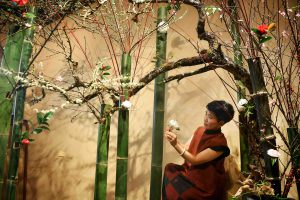
The flowering tree of the Thai, Muong, Tay, Nung, and other groups is a remarkable work of art. To create a five-tier tree adorned with thousands of blossoms, villagers spend nearly a month venturing into the forest to gather materials. They search for mulberry branches, cassava stems, and chuc buc wood to craft the branches and shape the flowers. The flowers of the tree are carved from chang vang wood; the core and trunk are made from mature Dendrocalamus barbatus bamboo. Each branch holds a floral nucleus composed of sections and multicoloured blossoms. Every branch tip is decorated with the image of a bird, and additional handcrafted items – ploughs, harrows, buffaloes, cattle made of bamboo, as well as five-coloured con balls – are attached. The beauty of the flowering tree lies entirely in the skilful hands of village artisans. The blossoms resemble coin-shaped flowers. After being carved, they are dyed with plant resin, steamed, dried, and then strung into garlands.

As an essential part of performance arts, festivals, and the spiritual life of the Thai and Muong, the neu pole, and especially the bong tree, commands deep reverence. True to its name, the tree is always “in full bloom,” radiantly coloured through the artisans’ craftsmanship, bringing splendour to the village each spring. The Kin Chieng Booc May festival – singing and dancing in celebration beneath the flower tree – is a distinctive traditional festival of the White Thai people and has been inscribed in the National Intangible Cultural Heritage list. Held on the full moon of the first lunar month, it unfolds over three days: the first dedicated to prayers, the second to further rites, and the third to communal celebration with songs and dances around the tree.
Villagers perform xoe cha dances to the lively sounds of traditional instruments such as drums, gongs, cymbals, and bamboo pipes. Various xoe cha dances include circling the neu pole, scarf dances, and bamboo-tube dances.

her festive best
“Playing with flowers” is a joy of spring and important village festivals. The flower tree symbolizes a life of proliferation, abundance, and the preservation of all species in nature. These are flowers of the earth, blooming from the hands of folk artisans during the festivals of the Thai and Muong people. With its artistic value and profound humanistic meaning, the flower tree is the soul and symbol of many ethnic groups. In recent years, festivals restoring the neu pole and processions of the neu pole and flowering tree have been organized in many places to honor this precious heritage value. At museums in Phu Tho, Son La, Thanh Hoa, and Nghe An provinces, the flower tree is displayed as an ethnographic artifact in the most solemn locations to introduce it to visitors.