Story: Vu Thi Hang
Photos: Amachau
For generations, Tu Quy paintings have embodied wishes for peace, prosperity, and harmony across the four seasons.
Tu Quy (Four Seasons) paintings are a traditional genre of congratulatory art composed of four panels, each representing one of the four seasons: spring, summer, autumn, and winter. According to ancient customs, when Tet approached and spring returned, Vietnamese families would refresh their homes and purchase Tu Quy paintings to display in their homes or gift to relatives and friends. These works often include Chinese or Nom verses celebrating the seasons or expressing wishes for prosperity and good fortune. Displaying Tu Quy paintings was believed to invite blessings of longevity (symbolized by passing through all four seasons and completing a full life cycle), peace, wealth, honor, and a large, harmonious family.
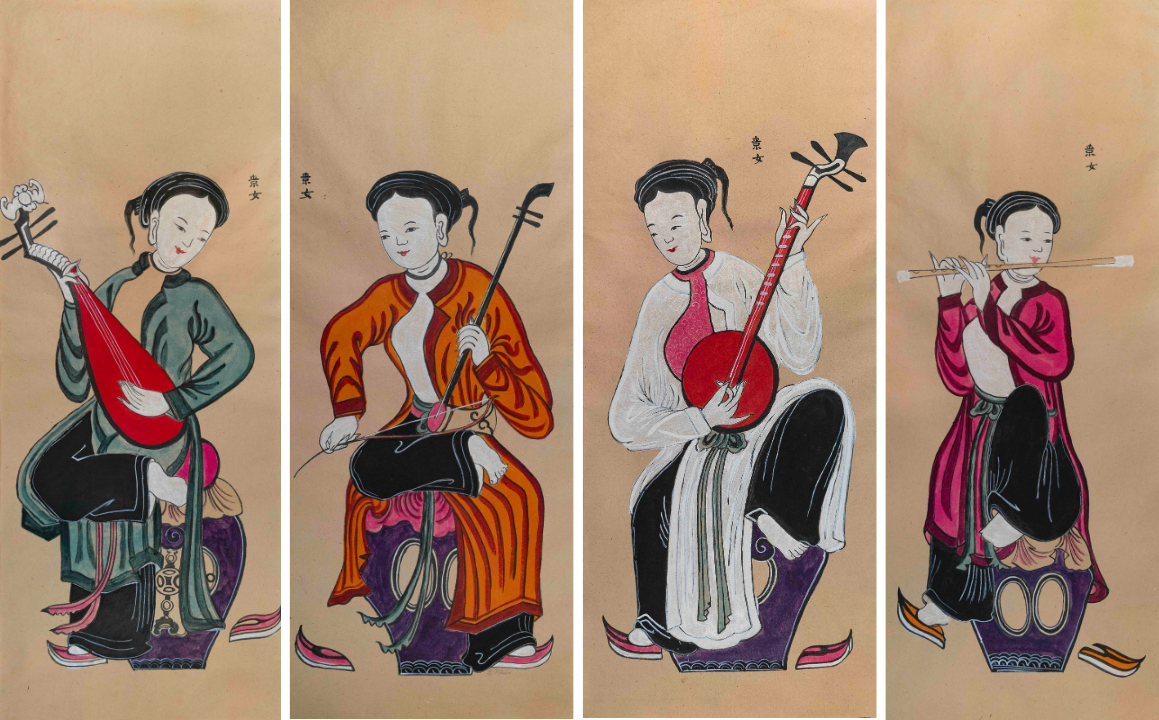
with a traditional instrument
This article introduces several notable Tu Quy sets from the Hang Trong and Dong Ho folk painting traditions preserved in the collection of the Vietnam Fine Arts Museum.
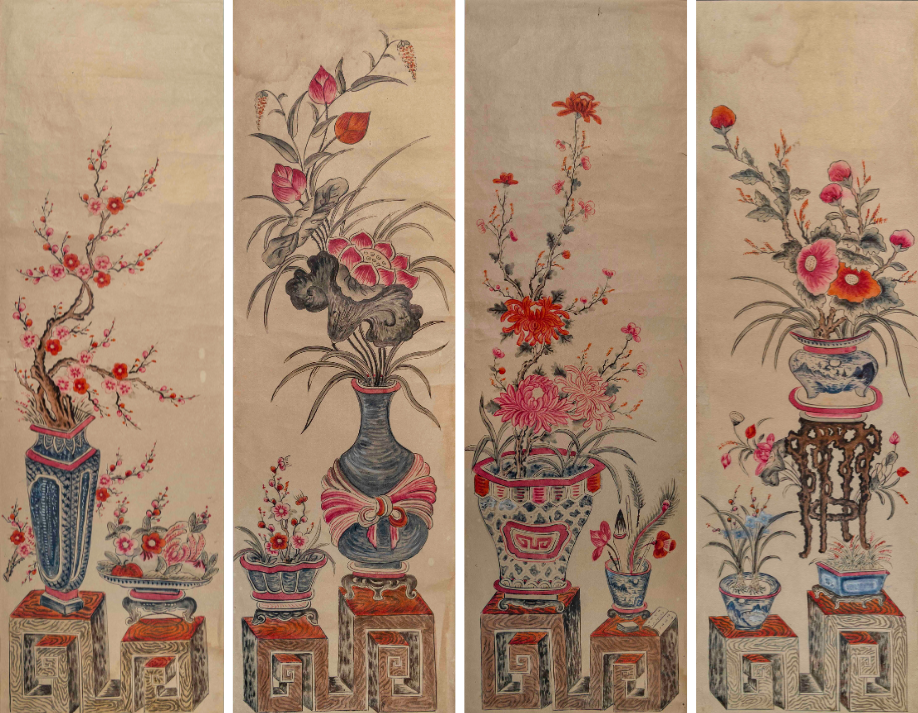
The first is a Tu Quy series from the Hang Trong tradition, depicting four vases of flowers – peach blossoms, lotus buds, chrysanthemums, and camellias – each representing a season. The ancients used the vase (binh hoa) as a metaphor, for the word bình is homophonous with bình in bình an (peace). The vases hold four noble flowers to express the wish: “Bình hoa thị phúc” (Harmony brings blessings).
To make the composition more dynamic and layered in meaning, folk artists ingeniously arranged the vases on tall stands or pedestal tables carved with meandering patterns symbolizing wind and rain, which nourish all things. The tall stands were often accompanied by fruit plates, small flower pots, or decorative objects – each conveying auspicious symbolism, such as Buddha’s hand fruit, narcissus, and orchids.
Also conveying good wishes, another Tu Quy set from the Hang Trong tradition, drawn by artists of the Thanh An shop, uses the allegory of four fruits corresponding to the seasons: the peach (spring), the lychee (summer), the pomegranate (autumn), and the custard apple (winter).
The spring panel depicts a peach branch heavy with blossoms and fruit, where a pair of magpies call to one another. Peach blossoms are believed to ward off evil spirits, while peaches symbolize longevity, and magpies herald happiness and good news. The Chinese inscription on the painting reads simply: “Peach blossoms showing their beauty in the spring.”
The summer panel depicts a lychee tree beside a large rock, on which a falcon is hunting for prey. At the foot of the rock blooms a cluster of bright peonies. The Chinese character for lychee fruit is le which is homophonous with the loi in danh loi (fame and profit). The falcon represents heroism, and the peony stands for nobility, honor, and wealth. The Chinese text on this painting seems to focus solely on this element: “Ultimately, this flower is wealth.”
Following the summer panel is the autumn painting, depicting a branch of brilliant red pomegranates. One fruit has been pecked open by a bird, revealing its many seeds. Because pomegranates contain numerous seeds, they symbolize the wish for a large, flourishing family blessed with many children and grandchildren. Pomegranate blossoms also represent good fortune.
Beneath the pomegranate tree stands a pheasant, accompanied by several gracefully rendered orchid clusters. The white pheasant evokes the legendary Viet bird from the era of the Hung Kings. Historical accounts note that during the reign of King Cheng of the Zhou Dynasty, the Hung King sent an envoy, said to bear the surname Viet Thuong, to present a white pheasant as tribute. The pheasant would only perch on branches that faced south. From this tale comes the proverb: “The Viet bird perches on the southern bough.”
The Chinese inscription on this painting conveys the meaning: “This bird is known as a species with literary refinement surpassing all others.”
The final panel portrays a custard apple branch heavy with fruit, its tip still blooming with snow-white flowers. The word for custard apple (na) is homophonous with the Na deity, who helps ward off evil spirits. Beneath the branch, clusters of chrysanthemums bloom with strength and pride in the winter cold. The Chinese inscription reads: “Though noble and splendid, the flower remains close to the people,” written in the Tan La style.
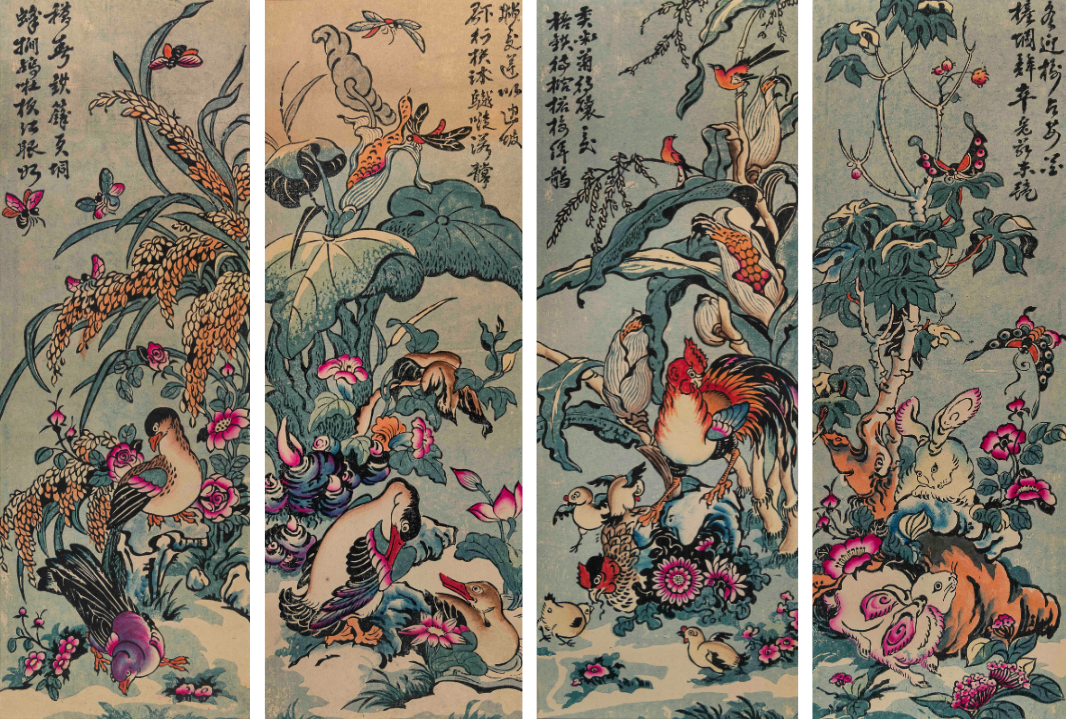
magical series of Dong Ho paintings
The Four Seasons – Four Fruits series was created by artists in Hanoi’s famous Thanh An painting studio, with copies widely circulated before the August Revolution of 1945. Though the set draws on Chinese cultural conventions, many believe these images also reveal distinctly Vietnamese sensibilities, integrating and reflecting strong elements of indigenous culture.
The Tu Quy series from the Dong Ho folk painting tradition is among the most distinctive four-panel sets, which bears a clear Vietnamese identity in both its artistic imagery and poetic Nom script. This set is affectionately known as: “Rice, Corn, Sweet Potato, Cassava.”
Rice, corn, sweet potato, and cassava are familiar crops and everyday foods for Vietnamese people. Spring is represented by an image of rice heavy with grain – not to suggest a spring harvest, but to highlight rice’s vital symbolic role in Vietnamese culture. The accompanying Nom verse reads: “Spring buds burst across the vast fields; Bees flutter, birds rest upon the rosy boughs with ease.”
The summer panel features the water taro plant, a species that grows abundantly along the edges of ponds and lakes and along the banks of rivers, streams, and canals. Summer is expressed through the accompanying Nom verse: “In the summer months, lotuses bloom by the shore; Beneath the cool shade, ducks glide and play in green waters.”
Furthermore, the image of a pair of ducks preening and swimming in a lotus pond is closely related to the Lien ap painting, which expresses aspirations for romantic love, academic success, and career advancement.
Autumn is portrayed by clusters of mature corn cobs ready for harvest. At the foot of the corn plants stands a rooster “instructing” five chicks beside a patch of chrysanthemums. The accompanying Nom verse reads: “Gentle chrysanthemums await golden sunlight; The corn plants wait near the tea stall by the banyan tree, and the rooster calls the hour.”
The flock of chickens in the autumn painting evokes the classic story “Giao ngu tu” (Educating Five Sons). This painting of a rooster and five chicks implies that all five children will receive a good education, study well, and attain high positions.
The winter panel concludes the series with a scene of rabbits frolicking beneath a cassava bush. The Nom verse states: “Winter approaches, the plum claims the first bloom; At the garden’s edge, leap healthy rabbits with soft fur.” The rabbits are good omens, representing health and prosperity.
Tu Quy paintings use symbolic imagery to convey heartfelt wishes, expressing hopes for peace, prosperity, successful careers, and joyful families with many descendants. In modern life, the tradition of collecting and displaying Tu Quy paintings – and folk paintings in general – has become less common. The market for Tu Quy panels printed on paper is smaller, yet appreciation for these images endures, with these iconic paintings recreated on more durable materials such as ceramics, wood, and bronze.