Story: Mai Phuong
Photos: Ly Hoang Long
Join us in exploring Ke Sat Village in Hai Phong – home to a special type of rice cracker colored with crimson gac fruit.
Strangely enough, as I sit amid stacks of banh da Ke (Ke sesame rice crackers) from Bac Giang, my hometown, now part of Bac Ninh, warming my hands over glowing embers and inhaling the aroma while black sesame seeds crackle and pop, my thoughts drift to another type of rice crackers – the crimson banh da gac Ke Sat from Hai Duong, now Hai Phong. The deep red color of this humble cracker has always evoked a sense of warmth and closeness.
Perhaps I remember Ke Sat rice crackers so vividly because, across Vietnam, they are unusual in bearing a natural red hue drawn from ripe gac fruit – a bright orange oval fruit native to Vietnam, typically weighing from 1.5 to 3 kg. Rice crackers exist in nearly every region, each variety with its own character. Some are tinted red with food coloring or other fruits, but those from Ke Sat, made from ripe gac and rice flour, leave a distinctly different impression. Once toasted, a gentle sweetness fills the air. On closer reflection, this scent evokes ripe gac drying on bamboo racks in village gardens, the faint smokiness of tree resin over glowing charcoal, the fragrance of rice from the fields, and the long seasons of rain and sun absorbed into the artisans’ hands. Sitting in the timeworn village of Ke Sat, holding a gac rice cracker as dusk falls, feels like holding the day’s final ember.
Freshly grilled gac rice crackers are crisp and aromatic, their gentle sweetness and nutty notes melting almost instantly on the tongue. Locals in Ke Sat often joke with visitors: “After the first one, you’ll want a second – then a third, a fourth, and still ask for more.” The craft of making these rice crackers dates back hundreds of years. No one recalls exactly when it began, only that it has been handed down through generations, sustaining countless families. Over time, the craft has been quietly refined to meet changing needs.
Pham Van Khanh, owner of the Ngoc Khanh gac rice cracker workshop, has devoted more than 30 years to the craft, beginning his work each day at 2 a.m. Making rice crackers is a meticulous, hands-on process that demands constant attention, from lighting the stove in the early hours to pulling the final batches from the oven late in the afternoon. In earlier years, village households relied on traditional methods and simple ingredients such as plain rice and sugar. In 1997, after extensive research and experimentation, Khanh and several fellow artisans began using ripe gac fruit as a natural coloring agent. Its subtle sweetness, combined with sesame seeds, coconut, and peanuts, created the distinctive flavor that defines gac rice crackers today.
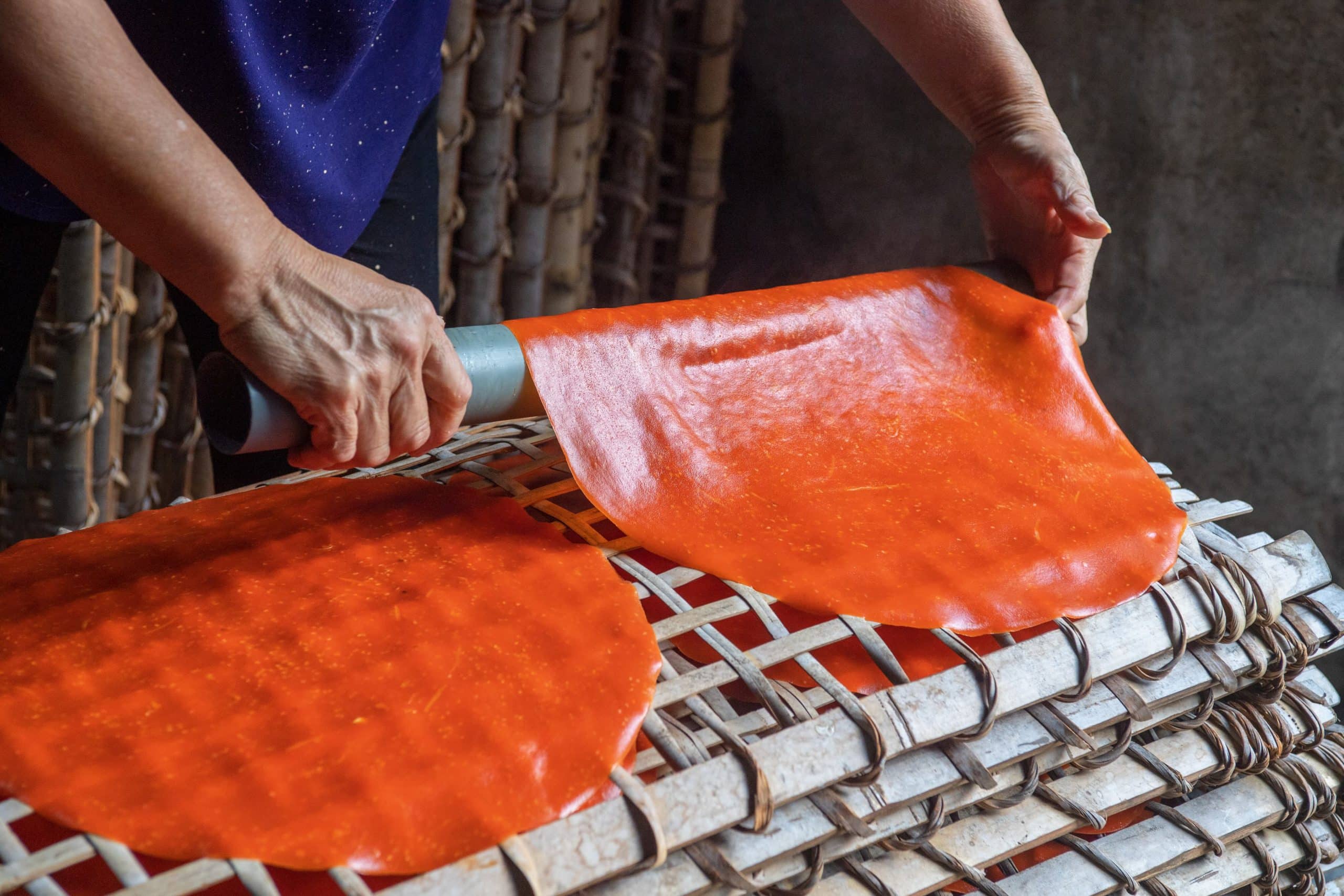
Once strained, the rice flour is poured into a stone mortar and thoroughly mixed with gac pulp and shredded coconut. After hours of mixing, the dough turns smooth and elastic, taking on a warm orange hue that signals it is ready to be steamed. Mrs. Ngoc, Mr. Khanh’s spouse, swiftly rolls out the dough on the mold. The batter is then spread thinly over a taut cloth stretched across the mouth of a pot and cooked in rising steam, much like banh cuon. Each large rice paper sheet emerges perfectly round.
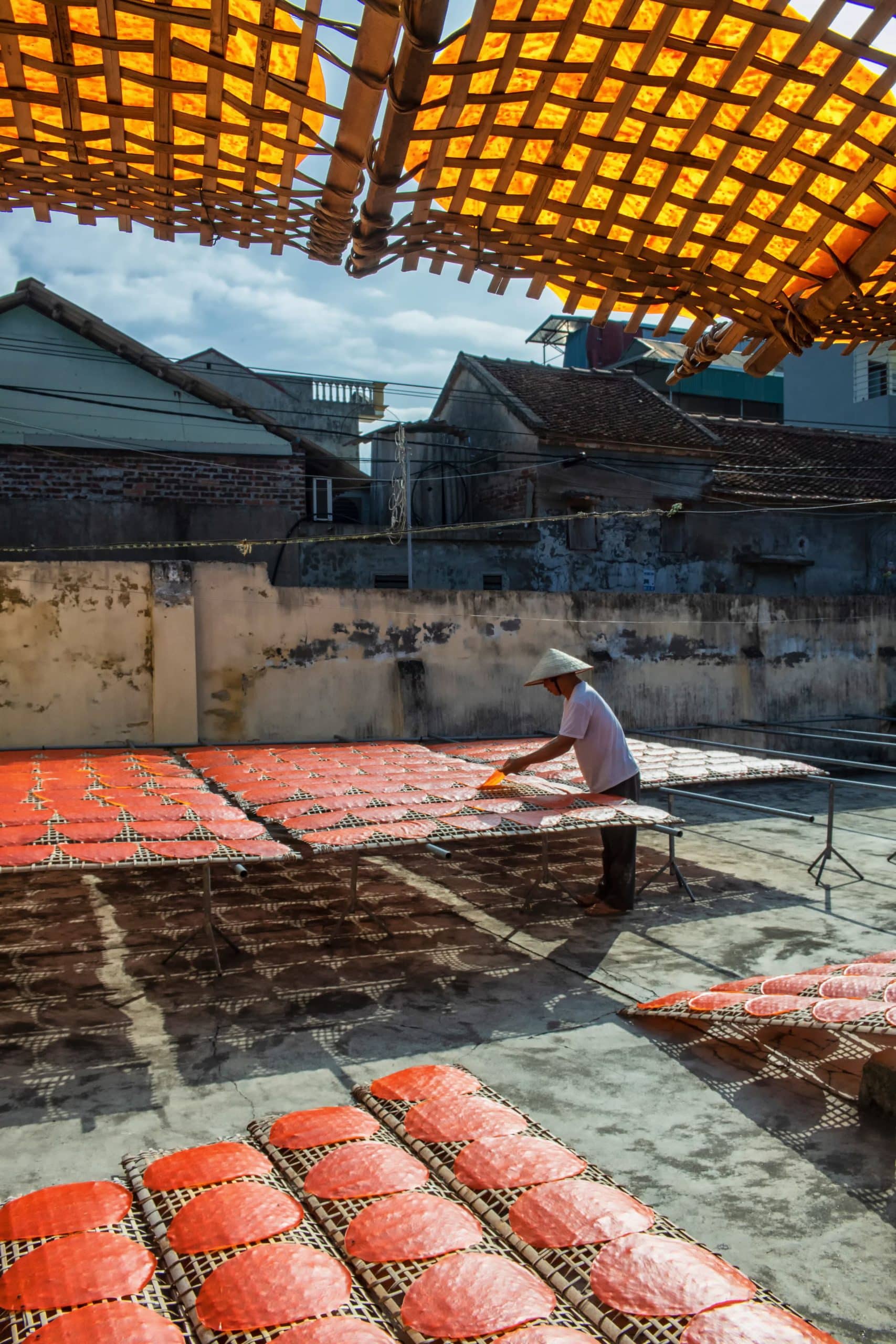
Mrs. Ngoc sprinkles sesame seeds, peanuts, and coconut evenly across the surface, then smooths another layer of batter on top. After one or two minutes, she lifts the lid, and the sheet is done. Using a bamboo tube, she gently lifts the rice paper and lays it flat on a bamboo tray. Five sheets fit neatly onto each tray, every movement precise and rhythmic to the second. Mr. Khanh then carries the trays outside to dry the crackers. When the sun rises, the courtyard fills with countless glowing red “suns,” still carrying a faint scent of smoke.
The drying stage demands experience. The cakes must sun-dry for two to three days to reach the right level of dryness, ensuring they puff evenly and turn light and crisp when grilled. They are then toasted over a charcoal stove, where careful control of the embers is essential – an art guided entirely by the craftsperson’s hands. Held above the glowing charcoal, each cake is toasted and shaped at the same time, either folded into a rectangle or rolled into a spiral, depending on preference. This step usually requires two people working together, as once the cake is lifted from the embers, it stiffens within a minute, becoming crisp and fragile.
Making banh da is a demanding, labor-intensive craft, something I know firsthand from having once lived among artisans in my home village. From dawn until dusk, they work steadily in the kitchen. Winter is bearable, but summer is punishing, the heat oppressive, sweat soaking through their clothes hour after hour. As Mrs. Ngoc explains, while the craft provides a stable income, it is far from plentiful. The long hours and physical strain, from early morning until late at night, have led many to abandon the trade. In Ke Sat, a banh da maker earns about 10 million VND per month, just enough to get by. For this reason, only those who truly love the craft and feel deeply rooted in their hometown choose to continue.
Today, only a handful of families continue to make banh da gac. They do so not merely to earn a living, but as custodians of their region’s beauty, preserving and safeguarding the flavors of home. As for me, born in the countryside with a wandering heart, I came to love the banh da gac of Ke Sat almost without noticing. Each time I pass through the old village of Ke, now part of Bac Giang ward, I eat some sesame rice crackers and long for a small “sun” from Ke Sat, gently scented with gac and carrying the deep, lingering taste of home.