Story: Luong Sang
Photos: Nguyen Hai, Luong Sang
Along the lower reaches of the Gianh River, Tan An Village preserves a centuries-old craft of making rice paper.
Rising at an elevation of more than 2,000 meters in the majestic Truong Son range, the Gianh River winds through layers of high mountains, flows gently across the lowlands, and finally empties into the sea. On the northern bank of its lower reaches lies a village that, for more than a century, has kept its hearth fires glowing day after day, producing fragrant rice paper imbued with the essence of the countryside.

Tan An Village, formerly known as Loc Dien, Ba Phuong, or by its folk name Phuong Bun Banh – a reference to its well-known rice paper craft – is now part of Tan Gianh Commune, Quang Tri Province. Set along a historic river that once marked the boundary between Dang Trong and Dang Ngoai during the period 1570 to 1786, the village retains the defining features of a traditional Vietnamese rural settlement. Ancient houses with dark brown tiled roofs, winding narrow lanes, and old banyan trees shading moss-covered gates all reflect gently in the flowing river.
On bright summer days, the village reveals a vivid palette, where golden rice fields blend with the shimmering yellow tones of rice paper sheets laid out to dry under the sun. Even the village elders cannot pinpoint when the craft of making rice papers began. Some believe it dates back to the days when settlers from the North moved south to expand the frontier lands, gradually developing into a local trade. It was only in the past century that Tan An gained renown for its rice paper, which is sold to communities both near and far.

Traditionally, rice paper was made on dry, sunny days, particularly during the summer months. In fine weather, the entire village was filled with warm golden hues and the unmistakable aroma of rice paper. Sheets were laid out along alleys, village roads, riverbanks, communal courtyards, and even rooftops, creating a striking contrast with the muted tones of old tiled houses and the deep blue-green of the river. Today, with advances in technology and changing market demands, rice paper can be produced year-round thanks to rolling and drying machines. Even so, veteran artisans insist that the most flavorful rice paper is sun-dried and made via traditional, labor-intensive methods.
To produce high-quality rice paper, artisans carefully select good rice, free from pests and moisture. The rice is soaked to remove impurities, thoroughly washed, and finely ground into a smooth batter. Fragrant sesame seeds are hulled with equal care. The ratio of sesame to rice flour varies by product, each following its own closely guarded recipe.
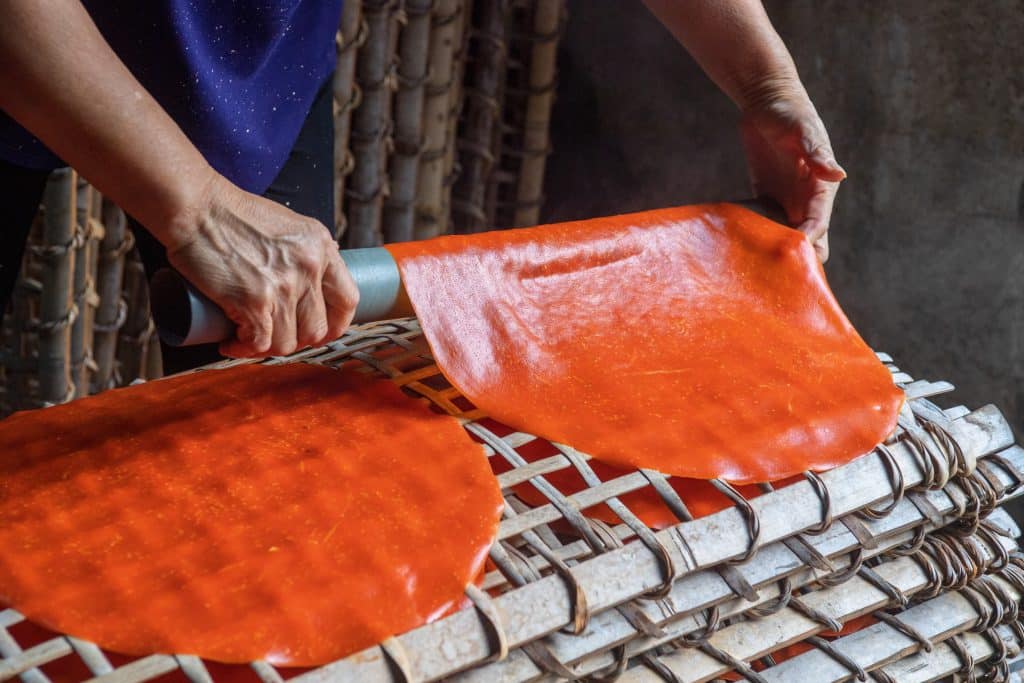
Steaming is the first step in shaping the rice paper and has a decisive impact on its quality. A ladle of well-mixed rice and sesame batter is gently spread into a thin, even circle over a taut cloth stretched above a pot of boiling water, then covered so the steam can cook the sheet. The artisan carefully lifts the rice paper and lays it on a woven bamboo mat measuring about 1.2 to 1.5 meters in length, each mat holding around five sheets of rice paper with diameters of 25 to 30 cm.

In this way, rice paper is born amid rising steam in simple, cozy kitchens and the steady, practiced movements of skilled hands. Sun-drying is a crucial final stage, ensuring the rice paper is dry yet supple, while preserving the pure aroma and taste of rice and sesame that evoke the countryside.
In the past, villagers carried rice paper to rural markets on shoulder poles, most notably to the nearby Ba Don Market. Over time, amid social change and economic development, Tan An’s humble specialty has found its way across the country and into international markets. Where there were once around ten different varieties, most producers today focus on three main types: hulled-sesame rice paper for grilling, ground-sesame rice paper for wrapping foods, and sweet sesame rice paper enjoyed as a snack. Production has also become more professional, with greater attention paid to food safety standards, improved packaging, and presentation.
From National Highway 1A, following Road 12A west for about 4 km, the ancient, poetic rice paper village of Tan An appears anchored to the Gianh River. A leisurely walk along its winding paths allows visitors to admire timeworn architecture and enjoy the warm, comforting aroma of freshly made rice paper.