Advertising



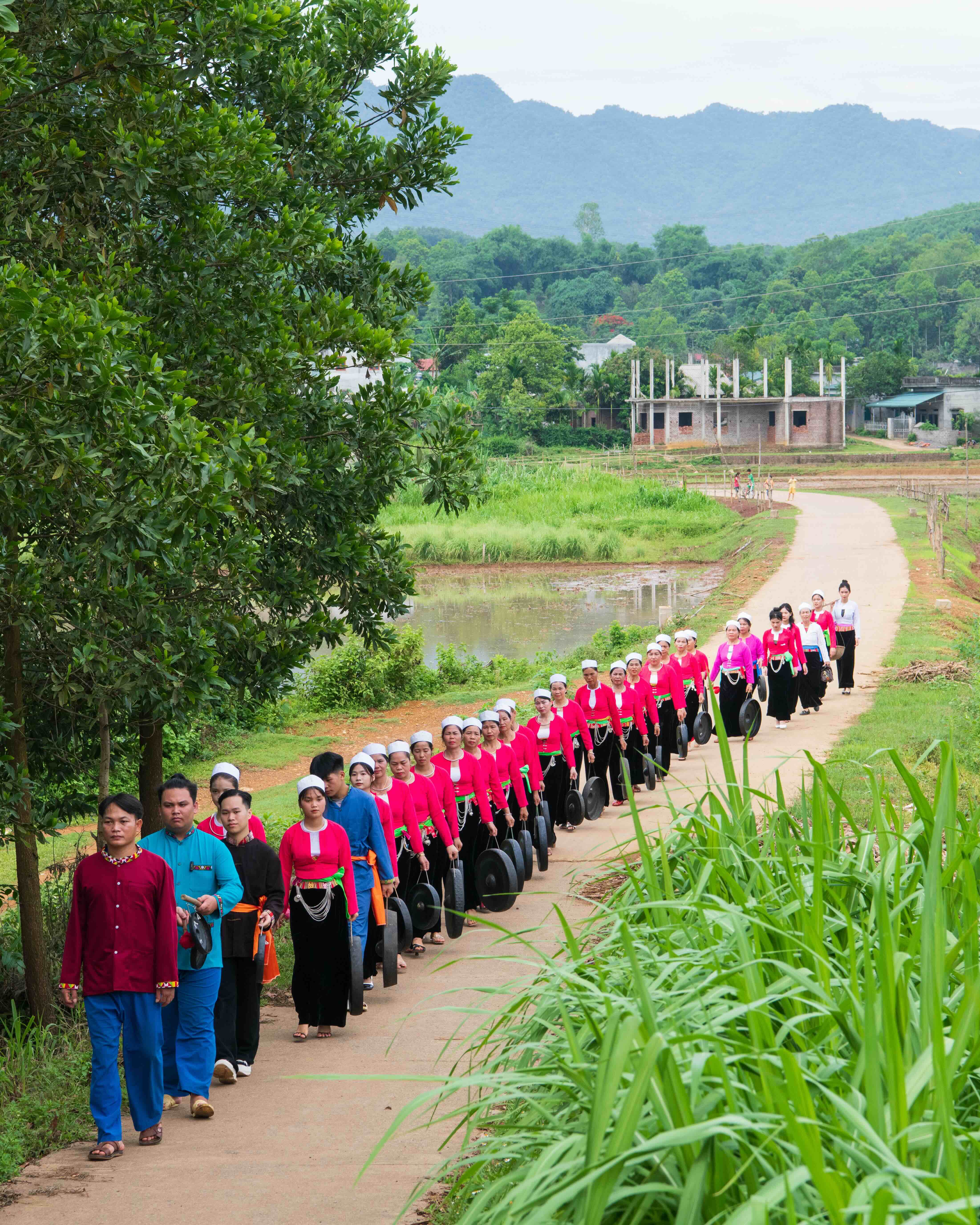
In the Muong language, Sac Bua – also known as xec bua or sec pua – literally means “carrying the gongs,” although some interpret this term as related to charms or magic, linked to beliefs and spiritual practices. Whatever its earliest meaning, the Sac Bua Festival has been held for so long that no one remembers when it began.
At its core, the Sac Bua ceremony is a celebration of blessings: wishes for a prosperous new year, good health, successful marriages, and bountiful harvests. The festive, optimistic, and romantic spirit of the Muong stands in contrast with their solemn funerary rites, led by Mo masters, which last for 12 days and consist of long ceremonial chants recounting creation, honoring the ancestors, and mourning the deceased. Because the Sac Bua is a joyous ritual, its blessings are conveyed through song – simple like the Muong farmers who perform them – and always accompanied by the resonant sound of gongs. Without the powerful, echoing tones of a gong, there can be no true Sac Bua. In the stillness of the mountains and woods, the gong’s deep timbre is commanding and enchanting.
The ritual demands a full ensemble of gongs – typically 12, each held by a young man. Some regions assemble more refined gong ensembles, with each instrument tuned according to scales favored by the Muong. In certain Sac Bua guilds in Thanh Hoa, for instance, the three smallest gongs, called the “mother gongs,” lead the melody, while nine larger gongs follow. In some places, the gong troupes are even larger, depending on the scale of the celebration.
Each Sac Bua gong troupe is led by a respected villager with a strong, resonant singing voice. The verses offer rustic blessings – sometimes improvised, sometimes exchanged in call-and-response with the householders. Over time, certain melodies have taken root, such as the Thuong Dang chant of the Muong in Hoa Binh and the Muong or Xuong singing of the Muong in Thanh Hoa. At times, the singing accompanies lively, graceful dances.
Typically, Sac Bua troupes travel in long winding processions – like a “dragon climbing into the clouds” – crossing streams and rice paddies to reach every stilt house in the village. The troupe leader sings at each stage: on the road, at the gate, at the foot of the stairs, to ask permission to enter, and to give thanks. Families joyfully welcome the troupe, offering a communal jar of wine, traditional Muong cakes such as Peng Pang (square sticky rice cakes), and generous feasts. Accompanied by echoing gongs and rustic lyrics that describe village life and affectionate feelings, a Sac Bua song in Hoa Binh might sound like this:
“We, the brothers of the Sac Bua troupe,
Come to wish your home a prosperous Tet.
Looking here, looking there,
Your buffalo and cattle fill the yard.
Your bundles of sticky rice last till the fifth month,
Your rice lasts till the tenth.
Our gong ensemble
Climbs nine mountain slopes,
Crosses ten layers of clouds…”
Traditionally performed in major Muong heartlands such as Muong Bi, Muong Vang, Muong Thang, and Muong Dong, the Sac Bua ritual gradually spread across the country, becoming an intangible cultural heritage of the Muong and even of neighboring ethnic groups. Its beauty lies in community solidarity, in village affection and neighborly harmony, captured in the Muong proverb: “Distant brothers are not as close as three neighboring households.” For the Muong, the Sac Bua is a village festival, and “when the village has festivities, the people have joy.” Their happiness is simple and sincere, untouched by modern disparities of wealth. Thus, the celebration – self-organized and self-performed – moves from house to house, offering mutual congratulations through an art form rooted in their shared culture.
The Sac Bua is an ancient cultural heritage with remarkable vitality, its power to endure rooted in a strong community spirit and the ease with which it can be organized. It supports a foundation of solidarity within the village and homeland. For this reason, the state has recognized Sac Bua singing as an intangible cultural heritage in several localities: Phu Le Sac Bua singing (Ben Tre, 2017), Sac Bua singing of the Muong in Ngoc Lac (Thanh Hoa, 2022), and Sac Bua singing in Dong Hoi and Minh Hoa (Quang Binh, 2024). The Sac Bua ceremony carries the innocent, rustic identity of Muong farmers-cum-artists, making it unique. This cultural treasure deserves to be nurtured as a spearhead for tourism within the cultural industry.